On this page
I get this question a lot because fountain pens look fragile, and the internet tends to turn storage advice into ritual. My short version after testing a few hundred pens is simple: no, fountain pens do not need to be stored upright all the time. For most modern pens, storing them flat is the safest all-around default, storing them upright with the nib up is useful when a pen is freshly filled or running a bit wet, and storing them nib down is something I only do briefly and on purpose.
If you’re trying to make a smart choice instead of buying twice, that answer comes from the same lens I use when I judge a pen: seal quality, feed consistency, cap design, nib wetness, how the ink behaves on normal paper, and whether the pen starts cleanly after sitting. A well-designed pen should tolerate real life, not demand museum handling. I have pens that start perfectly after a week stored flat in a case, and I have a few overly wet writers that behave better nib-up overnight. The trick is understanding what each position changes inside the feed rather than following one universal rule.
The Short Answer
If you are wondering should fountain pens be stored upright, my recommendation is this: store everyday fountain pens horizontally when they are inked and in regular rotation, store them upright with the nib up if you want to reduce the chance of ink pooling in the cap or to calm down a very wet pen, and avoid long-term nib-down storage unless you are trying to get a hard-starting pen flowing right before use. Flat storage is the best compromise between quick starts, leak control, and convenience.
Why not just say “always upright?” Because upright storage solves one problem while creating another. Nib-up storage can reduce burping and cap splatter during rest, but it also lets ink drain back from the feed, which means some pens write drier or need a scribble to restart. Horizontal storage keeps the feed more evenly primed. In my own testing, that usually produces the most predictable first line on the page, especially with cartridge-converter pens from brands like Lamy Safari fountain pens and Pilot Metropolitan fountain pens.
Comparison Table
The storage position changes how ink settles in the feed, how likely it is to creep into the cap, and how quickly the pen is ready to write. This is the practical comparison I use when deciding how to park a pen between sessions.
| Storage position | Start-up feel | Leak and cap mess risk | Best for | Main downside |
|---|---|---|---|---|
| Horizontal | Usually the most consistent first stroke | Low on well-sealed pens; moderate on very wet pens during travel | Daily writers, pen cases, drawers, desk trays | Some hot-running pens may still leave nib creep or cap spots |
| Upright, nib up | Can start slightly drier after sitting | Lowest risk of ink collecting in the cap | Freshly filled pens, wet nibs, long pauses, travel after pressure or temperature changes | Feed can un-prime a bit, so the first line may be less immediate |
| Upright, nib down | Very ready to write, often extra wet at first | Highest risk of saturation, nib creep, and cap mess | Short-term priming of a reluctant starter | Most likely to overfeed, burp, or stain the cap interior |
If you keep several pens inked, the most useful setup is usually a flat case plus a nib-up spot for exceptions. I like a fountain pen case for rotation pens and a simple fountain pen stand for the one pen that just filled or wrote a little too wet that day. That gives you control without turning storage into a chore.
Where Each Option Wins
Horizontal storage wins for normal daily use. If a pen is reasonably well made, capped properly, and used every day or two, flat storage is the least fussy choice. The feed stays more evenly saturated than it does nib-up, but not as aggressively loaded as it does nib-down. For desk use, drawers, and zip cases, this is the position I trust most. It is especially good for pens with moderate flow, snap caps that seal well, and converter systems that are not overly sensitive to movement. My first-person verdict here is blunt: if I am setting up a weekly carry with five inked pens, every one starts in a horizontal case unless it has already shown me a reason not to.
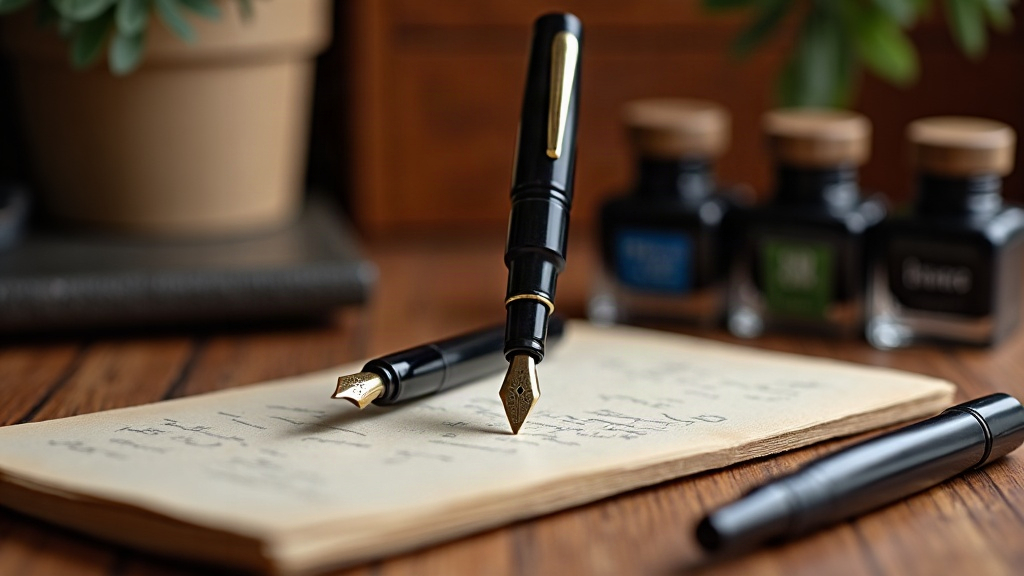
Nib-up storage wins when control matters more than instant start-up. This is the position I use after filling a pen to the top, after a cabin-pressure change, or when a pen has been leaving droplets inside the cap. Gravity is now helping you keep excess ink away from the nib and cap crown. That can be useful with very lubricated inks, broad nibs, or pens with ebonite feeds that run generous. If you store pens on a desk, a stand that keeps them nib-up is a sensible choice, especially for expensive pens you do not want rattling around loose. A hard-shell pen case also helps when the bigger problem is impact protection rather than ink behavior.
Nib-down storage wins only in narrow situations. If a pen has been sitting long enough to start dry, or if you have just cleaned and refilled it and want ink to reach the nib faster, a brief nib-down rest can help. I mean brief: a few minutes, maybe an hour, not your default storage strategy. In real testing, nib-down storage is the fastest way to turn a slightly wet writer into a messy one. I have seen it produce an immediate dark first line followed by over-saturation on absorbent paper, and I have also seen ink collect in the cap threads on pens that were otherwise perfectly behaved. It is a tactic, not a habit.
The best choice also depends on how full the pen is. A nearly full converter or piston reservoir has more ink mass ready to move with heat and motion, so nib-up can be smart during transport. A half-empty pen that you use every day is often happiest lying flat. Material matters too. A tight inner cap, a precise feed, and a nib tuned for moderate flow reduce the importance of storage angle. Cheaper pens with loose cap seals or overly wet feeds tend to be more position-sensitive, which is why some people think storage rules are stricter than they really are.
What the Tradeoffs Feel Like in Real Use
The practical difference is not abstract. You feel it in the first line, the cap interior, and the paper. A pen stored flat usually gives me the cleanest “uncap and write” experience. The nib touches down, the line appears without hesitation, and the flow is close to what I expect from the previous session. On decent paper, that means line width, shading, and dry time stay familiar. On cheap office paper, consistency matters even more because a surprise gush from an over-primed nib can push you straight into feathering and show-through.
Nib-up storage feels more controlled but slightly less immediate. The first stroke may be a touch lighter, especially with a fine nib and a dry ink. That is not a defect; it is the tradeoff for reducing saturation at the tip. I notice this most with pens that already run on the drier side. A Japanese fine that is stored nib-up for several days may need a small loop or two before it writes at full density. By contrast, a broad Western nib with a wet ink often benefits from that same treatment. One of my recurring testing notes is that upright nib-up storage makes an unruly pen feel better behaved, not necessarily better designed.
Nib-down storage feels great right up until it does not. The first line is often rich and immediate, but the pen can cross from “ready” into “loaded.” That shows up as extra gloss in the fresh line, slower dry times, and sometimes a blob if the pen gets jostled. If you write on coated paper or smooth notebooks, that heavier start can smear more easily under the hand. If you write on absorbent paper, it can widen the stroke enough that a medium nib stops looking like a medium nib. For left-handed writers in particular, that extra-wet opening line can be a nuisance rather than a benefit.
Travel adds another layer. When pens go into a bag, they deal with motion, temperature swings, and sometimes pressure changes. In that context I prefer empty pens, but for inked pens I lean nib-up if they are going to be idle for a while, then back to flat once I am settled. Protection matters as much as orientation, so a single pen sleeve or travel fountain pen case is often a more meaningful upgrade than obsessing over vertical versus horizontal alone. If the pen can bang around, no storage angle will save it from scratches or a cracked cap lip.
Maintenance habits also change the answer. A clean pen with a healthy cap seal is forgiving. A pen with dried ink in the feed, a converter not seated firmly, or a cap liner that no longer seals well becomes much more sensitive to storage orientation. When a pen misbehaves, I do not automatically change how I store it. I flush it, inspect the converter fit, check the cap, and then retest. My engineer’s-eye verdict is that orientation is often blamed for problems that really come from sealing or cleanliness.
Which One I Would Pick
If I had to give one default rule to most readers, it would be this: store inked fountain pens horizontally, and use upright nib-up storage selectively. That is the answer I would put on a workshop handout because it matches the way most modern pens actually behave. Flat storage gives the best balance of ready-to-write performance and low drama. Nib-up is a smart correction when a pen is too wet, freshly filled, or heading into a bag after being used. Nib-down is for temporary priming only.
My own routine is simple. Rotation pens live flat in a case. A pen that just got filled or one that has shown cap splatter goes nib-up overnight. A stubborn starter gets a short nib-down pause before I write, not permanent storage. If you want the shortest version possible of should fountain pens be stored upright, here it is: upright is sometimes useful, but flat is the real default. Choose the position that matches the pen’s behavior, not a rule that ignores it. That approach has kept my pens cleaner, more reliable, and frankly more enjoyable than any one-size-fits-all storage advice.
If you care about handwriting enough to notice comfort, smoothness, or line character, I would start with a fountain pen and a conservative, easy-flowing ink. If you mostly need a dependable tool for forms, meetings, and throw-it-in-a-bag convenience, I would still reach for a solid ballpoint without apology.
My bias is toward fountain pens because I enjoy the writing experience, but I do not think they are universally better. They are better for a specific kind of writer and a specific kind of use.
If you are deciding from scratch, I would not frame it as joining a tribe. I would frame it as matching a tool to your paper, pace, and tolerance for maintenance. That mindset usually leads to a smarter purchase and fewer disappointments.
Scope, uncertainty & affiliate disclosure
Writing feel is personal. Product details can vary by version, and NibGuide does not imply that every item mentioned was personally purchased or tested.
Some links may be affiliate links. NibGuide may earn a commission at no added cost to you; this does not determine editorial conclusions.
Leave a Comment