
On this page
Affiliate Disclosure: This post contains affiliate links. If you purchase through our links, we may earn a small commission at no extra cost to you. Last updated: March 2026.
How to Fill a Fountain Pen: Cartridge, Converter, and Piston Explained
If you’ve just picked up your first fountain pen and you’re staring at it wondering how to actually get ink inside, you’re not alone. Learning how to fill a fountain pen is the first real skill you develop as a new pen owner – and choosing the right filling system changes everything about how you interact with the hobby. I’ve owned over 200 fountain pens across every filling mechanism imaginable, from simple snap-in cartridges to elaborate vacuum fillers, and I can tell you from experience: the right system for your lifestyle makes the whole experience significantly more enjoyable.
In this guide, I’ll walk you through the four main filling systems – cartridge, converter, piston, and vacuum – with step-by-step instructions for each, honest pros and cons, common mistakes to avoid, and my recommendation for absolute beginners. By the end, you’ll know exactly how to fill your pen and keep it writing beautifully.
Why Your Filling Method Matters More Than You Think
The way a fountain pen holds ink affects almost everything about using it: how much ink it carries, how often you refill, which inks you can use, how easy it is to clean, and how you interact with the pen day-to-day. A cartridge system is plug-and-play simple. A piston filler gives you enormous ink capacity but commits you to one color for weeks at a time. A converter is the sweet spot – bottled ink access with the convenience of easy swapping.
Most beginner pens use cartridge-converter systems, meaning you can choose your approach. Higher-end pens are often dedicated piston fillers or vacuum fillers with built-in mechanisms. Knowing what you’re working with before you open the ink bottle is the difference between a satisfying five-minute fill and an ink-stained disaster.
Filling System 1: Ink Cartridges
What Is an Ink Cartridge?
An ink cartridge is a small, sealed plastic tube pre-filled with fountain pen ink. You snap it into the pen’s grip section, and it feeds ink to the nib through a sealed connection point. When it runs out, you pull it out and replace it – simple as swapping a battery.
Pros and Cons of Cartridges
- ? Extremely easy to use – no mess, no tools, no bottles required
- ? Perfect for beginners – lowest possible barrier to entry
- ? Travel-friendly – no risk of bottle spills or leaks in your bag
- ? Available almost everywhere – Amazon, office supply stores, pen shops
- ? Limited color selection – only what the manufacturer offers in cartridge form
- ? More expensive per ml than bottled ink over time
- ? Proprietary formats – Pilot cartridges don’t fit Lamy pens, and vice versa
- ? Single-use plastic waste – one cartridge, then it’s trash
Two Main Cartridge Sizes You Need to Know
- Standard International (long or short): Used by many European brands including Kaweco, Waterman, Monteverde, and some Lamy pens (Lamy uses a proprietary short format, technically).
- Proprietary formats: Pilot, Sailor, Pelikan, and others use their own cartridge sizes, incompatible with each other and with standard international sizes.
Always check which cartridge format your pen uses before buying replacements. A cartridge that doesn’t fit your pen can crack the feed if you force it.
How to Fill a Fountain Pen with a Cartridge – Step-by-Step
- Remove the cap and unscrew or pull apart the grip section from the barrel.
- Pull out the empty cartridge. It may require a firm tug. Have a tissue ready for the ink drip that follows.
- Insert the new cartridge. Push it firmly into the section until you feel or hear a click or snap. The cartridge pierces on an internal pin, releasing ink.
- Reassemble the pen and let it sit nib-down for 60-90 seconds to allow ink to flow into the feed.
- Test on scrap paper. If ink doesn’t start flowing, cap and uncap a few times, or gently squeeze a flexible cartridge. Still nothing? Soak the nib in room-temperature water for 5 minutes to clear any dried residue from storage.
Beginner tip: Don’t shake the pen to start ink flowing. Patience and gravity work better, and shaking can cause ink to spray out unexpectedly.
Filling System 2: Ink Converters
What Is an Ink Converter?
A converter is a reusable, refillable cartridge that fits in the same slot as a disposable cartridge. Instead of pre-filled ink, it has an empty reservoir that you fill by drawing ink up from a bottle. Once filled, it sits in the pen exactly like a cartridge and feeds ink the same way – but you can refill it indefinitely with any bottled ink you choose.
A converter is the single best upgrade you can make as a beginning pen user. It unlocks the entire world of bottled fountain pen ink – thousands of colors from dozens of brands – at a fraction of the ongoing cost of cartridges. In fifteen years of collecting pens, I’ve never met an enthusiast who regretted making the switch.
My favorite converter is the Pilot CON-70. Push-button filling mechanism, approximately 0.9ml ink capacity, and it works with all current Pilot pens including the Metropolitan. It’s well-built, easy to use, and widely available.
?? Pilot CON-70 Converter on Amazon (~$12)
Pros and Cons of Converters
- ? Access to thousands of bottled inks – any color, any brand compatible with your pen
- ? Significantly cheaper per ml than cartridges over time
- ? Reusable indefinitely – buy it once, use it forever
- ? Easy to swap colors – flush and refill in minutes
- ? Requires bottled ink – more gear, more initial setup
- ? Smaller ink capacity – most converters hold 0.5-1ml, less than a full large cartridge
- ? Some mess potential – filling from a bottle requires a bit of care
- ? Brand-specific fit – converters are proprietary to their pen brand
How to Fill a Fountain Pen with a Converter – Step-by-Step
- Assemble your supplies: pen with converter installed, a bottle of fountain pen ink, a paper towel or dedicated ink cloth.
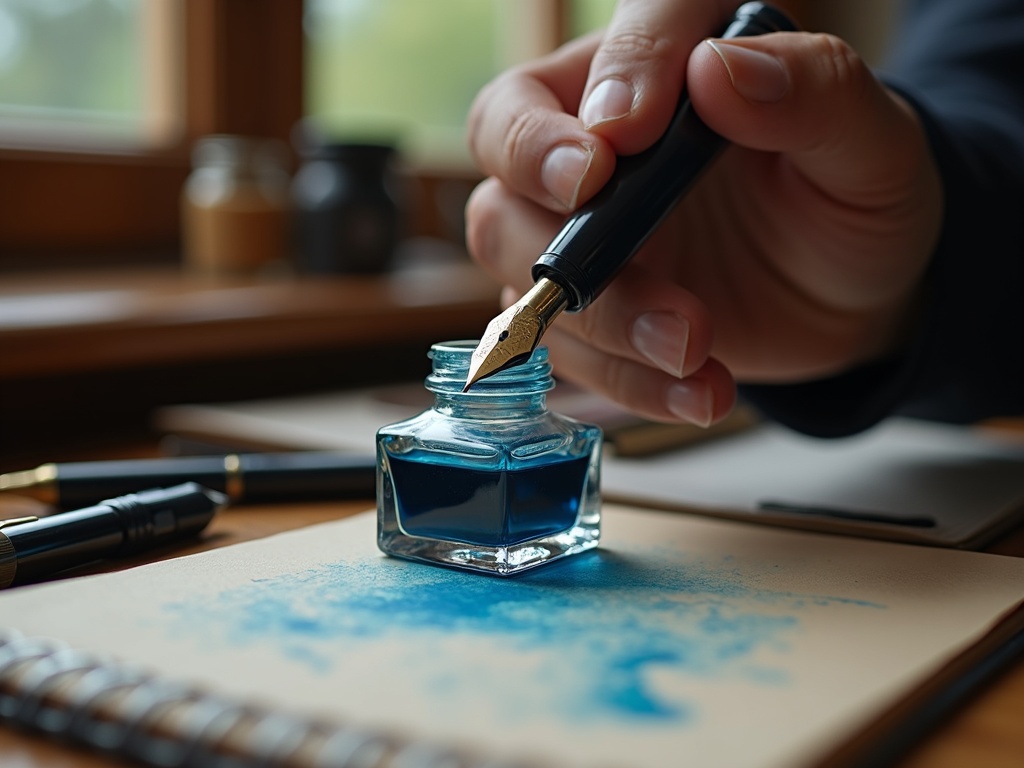
- Open the ink bottle and submerge the nib fully into the ink – not just the tip, but the whole nib and the lower part of the section. Shallow submersion draws in air bubbles.
- Activate the converter’s filling mechanism:
- Piston/twist converter: Turn the top knob counterclockwise to push the piston down, then clockwise to draw ink up.
- Push-button converter (Pilot CON-70): Press the button to push air out, release to draw ink in. Repeat 2-3 times for a full fill.
- Squeeze converter: Squeeze the rubber bladder to expel air while submerged, then release to draw ink in.
- Expel slightly and refill once. Push a small amount of ink back out, then draw up again. This removes air bubbles and seats the ink properly.
- Remove the pen from the ink bottle and wipe the nib and section thoroughly with a paper towel.
- Reassemble and test write on scrap paper. Flow should begin immediately.
Tips for Mess-Free Converter Filling
- Work over a paper towel or dedicated pen mat – ink drips happen
- Move the converter mechanism slowly and steadily to avoid splashing
- Keep an ink-stained cloth in your pen area; it will earn its keep
- Wash your hands immediately after – fountain pen ink stains fingers within seconds and some colors (particularly reds and purples) take days to fade
- Wipe the outside of the ink bottle opening before recapping to avoid sealing ink residue into the bottle
If you’re choosing a starter pen that takes the CON-70 converter, the Pilot Metropolitan (~$20) is my top recommendation for beginners. Brass body, great steel nib that writes smoothly even when pushed, reliable out of the box, and widely available. It’s the pen I hand to every newcomer to the hobby.
?? Pilot Metropolitan Fountain Pen on Amazon (~$20)
Filling System 3: Piston Filler
What Is a Piston Filler?
A piston filler is a built-in ink mechanism integrated into the pen’s barrel. Turning a knob at the end of the pen moves a piston inside the barrel, drawing ink directly from a bottle through the nib. There’s no separate converter to buy or lose – the pen barrel itself is the ink reservoir.
Classic piston-fill pens include the TWSBI Eco (~$35), the TWSBI 580, the Lamy 2000 (~$220), and the Pelikan M series. These pens typically hold 1.5-2.5ml of ink – significantly more than the 0.5-1ml of a converter, meaning you’ll refill far less frequently during heavy writing.
Pros and Cons of Piston Fillers
- ? Large ink capacity – go weeks between refills for daily writing
- ? Direct bottle filling – no converter to buy, lose, or maintain separately
- ? Full bottled ink access – same as a converter, but more of it
- ? Satisfying ritual – many enthusiasts genuinely love the piston filling process
- ? Commits you to one color – cleaning and refilling between colors takes more time
- ? No cartridge option – you always need a bottle of ink
- ? More complex maintenance – piston seals benefit from occasional silicone greasing
- ? Higher upfront cost – quality piston pens start around $35
How to Fill a Piston-Fill Fountain Pen – Step-by-Step
- Purge the pen first: Turn the piston knob toward the nib (clockwise on most pens) to push the piston fully down, expelling all old ink or air from the barrel.
- Submerge the nib deeply into your ink bottle – deeper than a converter fill. The nib and a good portion of the section should be in the ink.
- Turn the piston knob away from the nib (counterclockwise) slowly and steadily to draw ink up into the barrel. You’ll see ink rising through transparent barrels.
- Expel a small amount and refill once to remove air bubbles and achieve a fuller fill. Turn slightly back toward the nib to push a little ink out, then draw up fully again.
- Remove the pen from the bottle and wipe the nib and section thoroughly. Piston fills expose more surface area to ink, so there’s more to wipe clean.
- Cap and write.
Pro tip from experience: When filling a clear demonstrator piston pen, watch the ink level rise in real time – it’s deeply satisfying and lets you see exactly when you’ve achieved a full fill. Make sure the last fraction of the piston travel draws ink, not air.
Filling System 4: Vacuum Filler (Overview)
Vacuum fillers use a push-button plunger to create a vacuum inside the pen barrel, rapidly drawing ink up through the nib in one powerful motion. Pens like the TWSBI Vac700R, the Opus 88 series, and the vintage Vacumatic Parker use this system.
The main advantage: vacuum fillers hold enormous amounts of ink – often 2-4ml, more than any piston pen. The filling process is dramatically fast: push the plunger all the way down while the nib is submerged, hold briefly, release. The vacuum effect draws ink into nearly the entire barrel in one motion. It’s one of the most satisfying fills in the hobby.
For beginners, vacuum fillers are excellent second pens. The mechanism is straightforward, but they tend to cost more than starter cartridge pens, and the large ink commitment means less convenient color-switching. Start with a cartridge or converter system, get comfortable with ink and pen maintenance, then explore vacuum fillers when you’re ready to step up.
Common Fountain Pen Filling Mistakes (And How to Avoid Them)
In fifteen years of collecting and pen shows full of conversations with beginners, I see these mistakes constantly:
- Not submerging the nib deep enough. If you only dip the nib tip, you’ll draw in air with the ink. The full nib – and often the lower grip section – needs to be submerged in the bottle.
- Rushing the filling motion. Moving the piston or converter mechanism too fast creates air bubbles and incomplete fills. Slow and steady draws more ink every time.
- Skipping the expel-and-refill step. One quick draw leaves an air pocket in the reservoir. Always push a little out and draw up again to seat the fill properly.
- Using the wrong ink type. Never use pigmented inks, India ink, or acrylic inks in a fountain pen. These can permanently clog the feed and nib. Stick to water-based dye inks unless you specifically know your pen handles alternatives.
- Not wiping the nib after filling. Excess ink on the outside of the nib will transfer to your fingers, the paper, and the inside of the cap within seconds.
- Storing a pen nib-down with the cap off. Ink drips out. Store fountain pens capped, horizontally, or nib-up when resting for extended periods.
- Forcing a cartridge that doesn’t fit. If it doesn’t snap in easily, stop. Check that it’s the correct size. Forcing a mismatched cartridge can crack the feed permanently.
Which Filling System Is Best for Beginners?
My recommendation is always the same: start with cartridges.
Here’s my honest reasoning: when you’re new to fountain pens, you’re already navigating a learning curve involving nib angle, writing pressure, ink flow, and maintenance habits. Adding the complexity of bottles, converters, and cleanup to that initial experience can overwhelm the whole thing. Cartridges let you focus on writing – which is the point.
Once you’ve written for four to six weeks with a cartridge pen and you find yourself wanting more color variety or lower ongoing costs, buy a converter. Pick a bottle of ink you love. The transition is natural and easy.
The Pilot Metropolitan with a Pilot Blue or Pilot Black cartridge is my default beginner recommendation. When you’re ready for bottled ink, add the Pilot CON-70 converter – it drops in identically and opens up thousands of options without changing anything else about the pen you already know.
?? Pilot Metropolitan Fountain Pen on Amazon (~$20)
?? Pilot CON-70 Converter on Amazon (~$12)
Cleaning Between Fills
Every time you change inks, clean the pen first. Mixing inks without cleaning can cause unpredictable color shifts, chemical reactions between some ink formulas, and clogs in fine nib channels. Here’s the straightforward process:
- Remove the cartridge or empty the converter/piston by expelling all remaining ink onto a paper towel or back into the bottle (if the same ink).
- Fill with room-temperature water using the same filling motion, then expel it. Repeat until the water runs clear. Most beginner-friendly dye inks clean out in 3-6 flushes.
- Let the pen rest nib-down on a folded paper towel for 15-30 minutes to drain before loading new ink.
- Never use soap, hot water, or alcohol unless you specifically know your pen’s materials can handle it. Plain room-temperature water handles all water-based dye inks.
For piston and vacuum fillers, draw room-temperature water up through the nib and barrel rather than just flushing through the grip section. You want clean water running through the entire ink path – nib, feed channels, and reservoir.
If ink has dried in a pen during long storage, soak the nib section (not the barrel) in room-temperature water for several hours before attempting to flush. Most inks will dissolve with patience. Seriously resistant clogs can usually be resolved with a longer soak.
Frequently Asked Questions
Q: Can I refill a used ink cartridge?
A: Yes, with a blunt-tip syringe. Many enthusiasts refill used cartridges with bottled ink – it’s fiddly but works well and reduces plastic waste. Most cartridges can be refilled 3-5 times before the plastic or seal starts to degrade.
Q: How do I know when my pen is running low?
A: Ink flow becomes lighter and more inconsistent; the pen skips more frequently; the feed dries faster between strokes. Clear-barreled pens like the TWSBI Eco let you see the level directly. For opaque pens, you develop a feel for it – or briefly remove the section to check the cartridge.
Q: My pen won’t start after filling. What’s wrong?
A: Most likely an air gap between the converter/cartridge and the feed. Try holding the pen nib-down and gently flicking your wrist. If that doesn’t help, re-seat the cartridge or converter firmly. If ink still won’t flow, soak the nib section in room-temperature water for 5-10 minutes to clear any residue. Then try again on scrap paper.
Q: Can I switch inks without cleaning in between?
A: Not recommended. The only exception is refilling with the exact same ink – and even then, a flush every few weeks keeps the feed clear and prevents buildup. Always clean between different inks or different colors.
Q: Does the color of ink affect how I fill the pen?
A: No – the filling process is the same regardless of ink color. However, certain ink properties affect maintenance. Shimmer inks (with metallic particles) should only be used in medium or broader nibs and need more frequent flushing. Pigmented inks require strict maintenance schedules. Stick to standard water-based dye inks until you’re comfortable with pen care basics.
My First Ink Fill Story
My first fountain pen fill was a spectacular mess. I was 22, I had a brand-new Pilot Metropolitan, and I had just received my first bottle of Pilot Iroshizuku Kon-Peki. I dunked just the tip of the nib into the bottle – barely submerged – squeezed the converter button a couple of times, and assumed I’d filled it. I capped the pen triumphantly.
I had actually drawn mostly air with a small amount of ink pooled at the very bottom of the converter. I uncapped the pen five minutes later, pressed it to paper, and watched a single perfect ink bubble travel down from the nib and explode across my notebook in a satisfying but completely unintended abstract art moment. The entire Kon-Peki bubble detonated on the page in a vivid cerulean splash.
The fix was simple: submerge the nib deeper, expel once to clear the air, refill. Two minutes of correct technique and the pen wrote beautifully for the next three weeks without interruption.
That Metropolitan is still in my collection. The Kon-Peki splash on the notebook page is still there too. I kept it as a reminder that the learning curve in this hobby is real – and absolutely worth it.
– Alex Chen has collected and reviewed fountain pens for fifteen years. He currently keeps 200+ pens inked across his collection, with a focus on nib testing, ink behavior, and making the fountain pen hobby approachable for new enthusiasts.
External resources: The r/fountainpens community wiki is an excellent ongoing resource for beginners covering ink safety, pen maintenance, filling systems, and everything else you’ll encounter in this hobby.
Scope, uncertainty & affiliate disclosure
Writing feel is personal. Product details can vary by version, and NibGuide does not imply that every item mentioned was personally purchased or tested.
Some links may be affiliate links. NibGuide may earn a commission at no added cost to you; this does not determine editorial conclusions.
Leave a Comment