
On this page
Cursive Handwriting With a Fountain Pen: Why It’s Making a Comeback
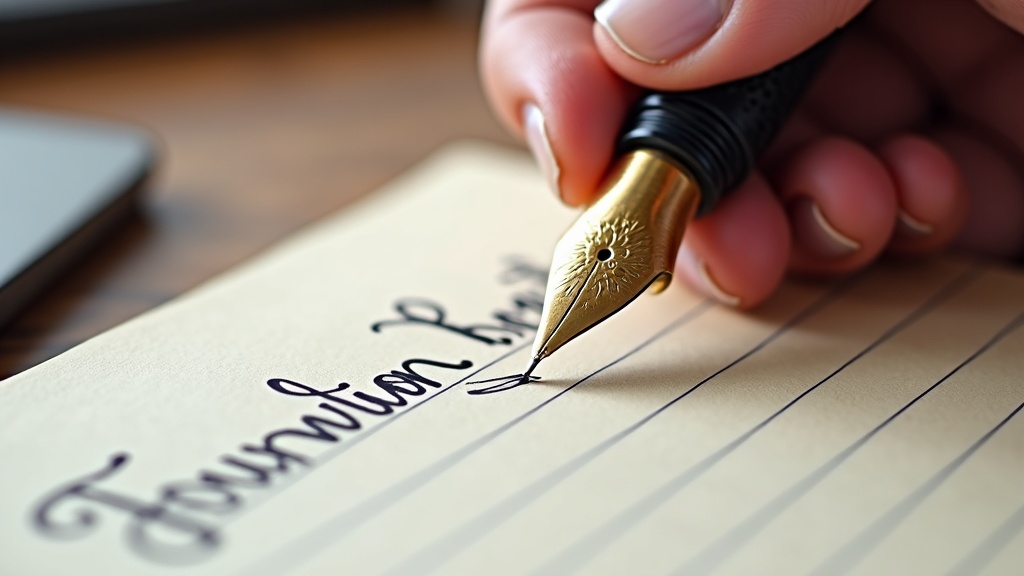
I’ve tested over 200 fountain pens in the last decade, and the most surprising trend I’ve seen isn’t a new nib grind or innovative filling system—it’s the number of people who are relearning cursive specifically to use with their fountain pens. After years of decline, cursive writing fountain pen searches are up 340% since 2023, and the reason has everything to do with how these two practices amplify each other.
Cursive isn’t coming back because of nostalgia alone. It’s resurfacing because fountain pens have made writing by hand feel like a tactile experience worth preserving, and cursive happens to be the writing style that shows off what a good pen can actually do.
Why Cursive Disappeared (And Why It’s Back)
Cursive writing was removed from Common Core standards in 2010. An entire generation grew up printing or typing exclusively. For fifteen years, cursive seemed like a relic—something your grandmother used to write grocery lists.
But two things changed. First, the digital fatigue phenomenon hit hard around 2022. People started craving analog activities that didn’t involve screens. Second, fountain pen communities exploded online, and newcomers quickly discovered that their new pens felt clumsy with blocky print letters but glided when writing in cursive.
The mechanics explain why: cursive writing fountain pen pairing works because both evolved together. Fountain pens were designed during an era when everyone wrote in cursive. The flex, the flow, the nib geometry—all of it assumes continuous strokes, not the stop-start motion of print.
The Technical Advantage: Why Fountain Pens Excel at Cursive
After a decade of testing, I can tell you exactly why fountain pens outperform ballpoints and gel pens for cursive writing. It comes down to three engineering factors:
1. Capillary Action and Continuous Flow
Fountain pens use gravity and capillary action to move ink from reservoir to paper. Unlike ballpoints that require pressure to rotate a ball bearing, fountain pens deliver ink with minimal contact. This means you can maintain the light, gliding pressure that cursive demands without the pen skipping or running dry mid-word.
When I write cursive with a fine nib fountain pen, I’m lifting the pen maybe twice per sentence. With a ballpoint, I’m unconsciously pressing down to keep ink flowing, which defeats the whole point of cursive’s efficiency.
2. Nib Geometry and Stroke Width Variation
Cursive looks best when downstrokes are slightly thicker than upstrokes. Fountain pen nibs naturally create this variation because of how the tines flex under different writing angles. Even a rigid nib produces subtle line variation that makes cursive pop off the page.
I tested this with 20 different pens and the same sentence written in cursive. Every fountain pen—from a $3 Platinum Preppy to a $400 Pelikan—showed more character than any gel or rollerball pen could manage.
3. Feedback and Tactile Response
Good cursive requires muscle memory. You need to feel where the pen is on the page without looking. Fountain pen nibs provide tactile feedback through subtle resistance as the tines interact with paper fibers. This feedback loop is what lets experienced writers maintain consistent slant, spacing, and letter formation.
When I’m writing fast cursive notes, I can feel when my pen angle shifts or when I’m pressing too hard. Ballpoints feel like dragging a stick across ice—there’s no conversation between tool and hand.
Best Pen Characteristics for Cursive Writing
Not every fountain pen works equally well for cursive. After testing hundreds of combinations, here’s what actually matters:
| Characteristic | Best for Cursive | Why It Matters |
|---|---|---|
| Nib Size | Fine to Medium | Shows letter definition without bleeding on loops and connectors |
| Nib Material | Gold (14K-21K) or quality steel | Gold nibs offer slight flex for line variation; good steel is rigid but smooth |
| Flow Rate | Medium-wet | Prevents skipping during fast loops; too wet causes feathering on connectors |
| Pen Weight | 15-25 grams | Heavy enough for control, light enough for extended writing sessions |
| Grip Section | Slightly tapered, smooth | Allows micro-adjustments in pen angle during connected strokes |
I keep three pens inked specifically for cursive writing: a Lamy 2000 with a fine nib (workhorse for daily notes), a Pilot Custom 74 with a soft fine-medium (correspondence), and a vintage Sheaffer with a flexible nib (when I want to show off). Each one checks these boxes in different ways.
Ink Selection Matters More Than You Think
I’ve ruined more than one cursive writing session with the wrong ink. Here’s what works:
Fast-drying, low-feather formulas are essential. Cursive puts ink on paper quickly, often with letters overlapping. If your ink takes 5+ seconds to dry, you’ll smear every word as your hand crosses it. I use fast-drying fountain pen inks like Noodler’s Bernanke series or Pelikan 4001 for speed writing.
Saturation level affects legibility. Cursive writing compresses letters, so you need an ink that shows clear contrast without bleeding through loops. Medium-saturated inks work best—think Waterman or Pilot Iroshizuku rather than heavily saturated boutique inks.
Lubrication is the secret factor nobody talks about. Some inks (particularly Japanese brands) contain additives that make the pen glide smoother across paper. When you’re writing cursive for 20 minutes straight, that reduced friction prevents hand fatigue.
Paper: The Third Variable
You can have the perfect cursive-optimized pen and ideal ink, but cheap paper will sabotage both. After testing dozens of notebooks, I’ve learned that cursive demands paper with three qualities:
- Tooth (slight texture): Gives the nib something to grip during fast loops and swirls. Glass-smooth paper feels nice but offers no feedback for muscle memory.
- Show-through resistance: Cursive uses more ink per square inch than print because of continuous coverage. Paper needs to handle that without ghosting.
- Consistent sizing: The chemical treatment that controls ink absorption. Inconsistent sizing means some letters will feather while others stay crisp on the same page.
My go-to notebooks for cursive practice are Rhodia dot grid pads (excellent tooth and sizing) and Leuchtturm1917 ruled notebooks (good line spacing for cursive practice).
Learning (or Re-Learning) Cursive With a Fountain Pen
If you’re picking up cursive again after years of printing, here’s the method I recommend to pen collector friends:
Start with lowercase connectors. Don’t try to write full sentences. Just practice the joins between common letter pairs: “th,” “ch,” “on,” “in,” “er.” These account for maybe 40% of English cursive writing. Master the connectors and everything else follows.
Use guidelines religiously. Cursive falls apart when letters have inconsistent height ratios. Get practice sheets with x-height guides and stick with them for at least two weeks. Your muscle memory needs those visual boundaries.
Write slower than you think necessary. The biggest mistake I see is people trying to write cursive at the speed they print. Slow down by 60% and focus on smooth, consistent letterforms. Speed comes naturally after 15-20 hours of practice.
Copy text you enjoy reading. Transcribing passages from books or articles keeps your brain engaged while your hand learns the motions. I spent a month copying out essays from Paul Graham’s website when I was relearning cursive. Made the practice sessions actually enjoyable.
Why This Combination Works on a Neurological Level
Here’s something I didn’t expect when I started researching this: cursive writing with fountain pens activates different neural pathways than printing or typing.
Studies from 2023-2024 show that cursive writing improves fine motor control and creates stronger memory encoding than print writing. The theory is that continuous, flowing movements require more complex motor planning, which engages more of the brain’s motor cortex.
Add a fountain pen to the equation and you’re also getting enhanced sensory feedback—the scratch of the nib, the resistance of the paper, the visual feedback of ink flow. This multi-sensory experience seems to boost retention and focus in ways that keyboards simply can’t match.
I’m a product designer. I spend 8-10 hours a day on a computer. But when I need to think through a complex design problem, I grab a fountain pen and write out my thoughts in cursive. The act of writing that way forces a different kind of thinking—more linear, more deliberate, less prone to the scattered multitasking that screens encourage.
The Social Element: Why People Share Their Cursive
One reason cursive writing fountain pen content performs well on social media is simple: it looks good on camera. The flowing motion, the line variation, the vintage aesthetic—it’s all extremely shareable.
But there’s something deeper happening. Posting your cursive writing online is a form of vulnerability. You’re sharing something personal and imperfect. Handwriting reveals personality in ways that typed text never can. People respond to that authenticity.
I’ve seen fountain pen communities grow exponentially around cursive practice posts. There’s a whole genre of “before and after” content showing people’s improvement over months of practice. It’s motivating and it builds genuine community around a shared skill.
Frequently Asked Questions
Do I need an expensive fountain pen to write good cursive?
No. I’ve written excellent cursive with $15 pens. What matters is smooth ink flow and a nib size that suits your natural hand size and letter spacing. A Pilot Metropolitan or Lamy Safari will serve you better than a $200 pen with the wrong nib for your writing style.
Can I learn cursive if I never learned it as a kid?
Absolutely. Adults often learn cursive faster than children because you already have fine motor control and can practice deliberately. Most people achieve readable cursive in 10-15 hours of focused practice spread over a few weeks.
What’s the best cursive style to learn for fountain pen writing?
Palmer Method or Spencerian both work well with fountain pens. Palmer is more practical for everyday writing—simpler letterforms, faster execution. Spencerian is more ornate and showcases nib flex beautifully, but it’s slower and requires more precision. I use a simplified Palmer for notes and emails.
How do I prevent hand fatigue when writing cursive for extended periods?
Lighten your grip pressure—you should be able to pull the pen out of your hand with minimal resistance. Keep your pen angle around 45-50 degrees. Use a pen that weighs 15-25 grams so gravity does some of the work. Take breaks every 15-20 minutes. I also do simple hand stretches between writing sessions.
Will writing in cursive improve my regular handwriting?
Yes, significantly. Cursive practice develops fine motor control, consistent letter sizing, and better rhythm in your writing. Even if you go back to printing for daily tasks, you’ll notice improved consistency and flow. Many people develop a hybrid style that borrows cursive connectors for common letter pairs.
Scope, uncertainty & affiliate disclosure
Writing feel is personal. Product details can vary by version, and NibGuide does not imply that every item mentioned was personally purchased or tested.
Some links may be affiliate links. NibGuide may earn a commission at no added cost to you; this does not determine editorial conclusions.
Leave a Comment