
On this page
Your first fountain pen will probably feel wrong—too light, too smooth, like the nib is skating instead of writing. That’s normal. After a decade of collecting and testing over 200 pens, I can tell you the single most important thing: grip pressure matters more than anything else, and you’re using too much of it.
Most people fail with fountain pens because they apply ballpoint pressure to a tool that works on capillary action. The ink flows from the feed to the paper through a tiny channel in the nib, and you’re just guiding it—not forcing it. Let me walk you through exactly how to make this work.
Before You Start: Understanding Your Fountain Pen
Fountain pens have three essential components that work together. The nib is the metal tip that touches paper. The feed sits underneath and regulates ink flow. The filling mechanism (cartridge, converter, or piston) holds the ink. Unlike ballpoint pens that use thick paste, fountain pens use liquid ink that flows through gravity and capillary action.
This fundamental difference changes everything about how you write. A ballpoint requires 1-2 pounds of pressure to roll the ball and deposit ink. A fountain pen needs maybe 2-4 ounces—just enough contact to let the ink wick onto the paper fibers.
Step 1: Fill Your Pen Correctly
If you’re starting with a cartridge fountain pen, push the cartridge firmly into the back of the grip section until you feel or hear a click. Don’t twist—just push straight. Some cartridges take 15-30 seconds to start flowing into the feed, so give it time.
For converter-filled pens, submerge the entire nib and part of the grip section into your ink bottle. Twist or press the converter mechanism (depending on type) to draw ink up. Do this 2-3 times, expelling and refilling, to eliminate air bubbles. Wipe the nib and feed clean before writing.
The Paper Test
Before you write anything important, scribble on scratch paper for 30 seconds. This primes the feed and ensures ink is flowing to the tip. If nothing comes out, gently tap the nib on paper (not hard—just contact) or hold the pen nib-down for 10 seconds to encourage flow.
The Correct Grip: Less Is More
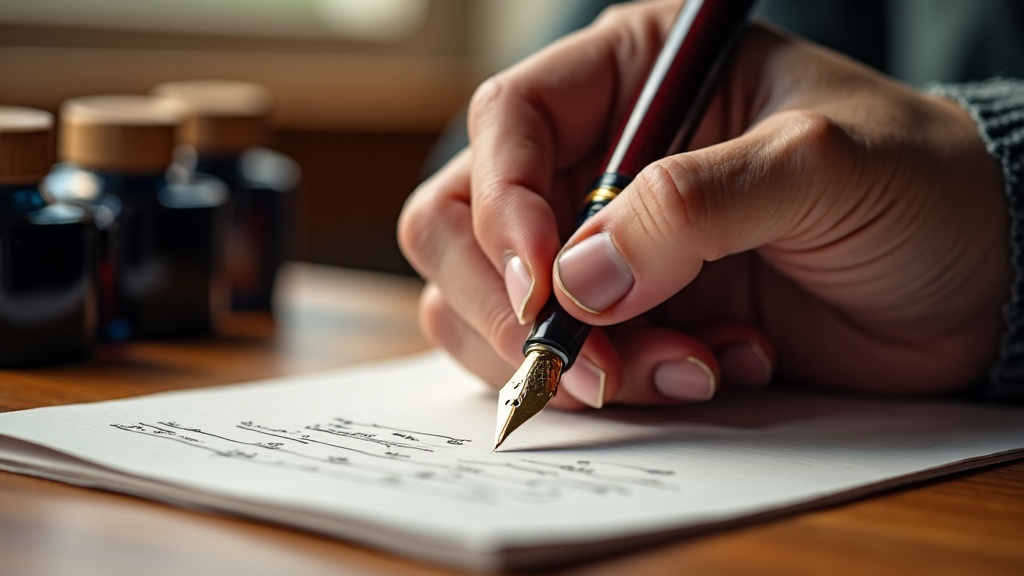
Hold the pen between your thumb and index finger, resting it on your middle finger. The grip should be about 1-1.5 inches from the nib—farther back than you’d hold a ballpoint. Your fingers should barely be squeezing. If your fingertips turn white or you feel tension in your hand after 30 seconds, you’re gripping too hard.
Here’s the test I use with every new pen: can you slide the pen forward and backward in your grip with minimal friction? If it’s locked in place, relax your fingers.
Nib Angle and Pressure: The 40-55° Rule
Most fountain pen nibs are designed to write at a 40-55° angle to the paper. Too steep (vertical) and you’re writing on the very tip, which can feel scratchy. Too shallow (flat) and the nib won’t make proper contact with the feed channel.
| Angle | What Happens | How It Feels |
|---|---|---|
| Too Steep (70°+) | Nib tip digs into paper fibers | Scratchy, catching, inconsistent |
| Correct (40-55°) | Full nib contact with feed channel open | Smooth, consistent, effortless |
| Too Shallow (20-30°) | Feed can’t reach paper, ink flow blocked | Dry, skipping, requires extra pressure |
The nib should glide across the paper with almost no resistance. If you feel friction, you’re either pressing too hard or writing at the wrong angle. Adjust your wrist position rather than your finger pressure.
Writing Technique: Let the Pen Do the Work
Start with large, slow letters—I recommend practicing lowercase loops like “e,” “a,” and “o.” Keep the nib in contact with the paper continuously rather than lifting between strokes. Fountain pens perform best with smooth, connected movements.
Common First-Timer Mistakes
- Death grip syndrome: Squeezing the pen like it’ll escape. Solution: practice holding the pen with just your thumb and index finger—no middle finger support—for 10 seconds to feel how little grip you actually need.
- Ballpoint muscle memory: Pushing down to “make” the ink flow. Solution: if you’re pressing hard enough to flex the nib (you’ll see the tines separate), you’re using 10x too much force.
- Speed rushing: Writing at your normal ballpoint speed. Solution: slow down by 30-40% for the first week. Fountain pens reward smooth, deliberate movements.
- Paper incompatibility: Using copy paper or cheap notebooks. Solution: start with fountain pen friendly paper (Rhodia, Leuchtturm, or Clairefontaine) that won’t feather or bleed.
Choosing Your First Fountain Pen
After testing dozens of beginner pens, I recommend starting with a medium nib rather than fine. Medium nibs are more forgiving—they tolerate angle variation better and flow more consistently. Fine nibs can feel scratchy if you haven’t developed light-handed technique yet.
The best first pens share specific characteristics: posted weight under 25g, medium steel nibs, cartridge/converter filling, and grip sections between 9-11mm diameter. Pilot Kakuno and Lamy Safari exemplify this formula—they’re engineered to teach good habits.
Nib Size Comparison
| Nib Size | Line Width | Best For | Beginner Friendly? |
|---|---|---|---|
| Extra Fine (EF) | 0.4-0.5mm | Tiny handwriting, cheap paper | ❌ Can feel scratchy |
| Fine (F) | 0.5-0.6mm | Small handwriting, detailed work | ⚠️ Requires light touch |
| Medium (M) | 0.6-0.8mm | Normal handwriting, everyday use | ✓ Most forgiving |
| Broad (B) | 0.8-1.0mm | Large handwriting, signatures | ✓ Smooth but uses more ink |
Your First Week: What to Expect
Days 1-2: Everything feels weird. Your handwriting will look different—probably worse. The pen might feel too slippery or the flow too wet. This is normal adaptation.
Days 3-4: You’ll start feeling when you’re using too much pressure. Your hand will fatigue less during long writing sessions—that’s the first real benefit revealing itself.
Days 5-7: Muscle memory begins forming. You’ll catch yourself using fountain pen grip on ballpoints. The writing angle will feel natural rather than conscious.
Week 2+: Most people develop consistent technique by day 10-14. Your handwriting will have evolved—often more legible because you’re forced to slow down and be deliberate.
Maintenance: Keep It Flowing
Fountain pens need minimal maintenance if used regularly. If you write daily, just refill when empty. If you’re not using the pen for 2+ weeks, flush it with water to prevent ink from drying in the feed.
To clean: disassemble the pen (remove cartridge or empty converter), run lukewarm water through the nib and feed until it runs clear, then let air dry nib-down on a paper towel for 2-4 hours. I clean my rotation every 4-6 weeks, or when changing ink colors.
Never use hot water, soap, or alcohol unless you’re dealing with stubborn staining from certain inks. For bottle ink, make sure it’s specifically formulated for fountain pens—India ink and calligraphy ink will clog your feed permanently.
Troubleshooting Common Issues
Pen skips or stops flowing: Usually air bubbles in the feed. Try the “knock test”—gently tap the back of the pen (not the nib) against your palm to encourage ink flow downward. Or prime the nib by touching it to a damp paper towel.
Too much ink flowing (blobbing): Either you’re pressing too hard, writing on absorbent paper, or the pen is designed with a wet flow. Not necessarily a problem unless it feathers. Consider higher quality paper.
Scratchy feeling: Check your angle first, then pressure. If it’s still scratchy on all angles with light pressure, the nib might have a manufacturing issue (misaligned tines or a sharp tip edge). This is why I recommend buying from retailers with easy returns for your first pen.
Ink on fingers: You’re holding too close to the nib, or the grip section has ink residue. Clean the grip section thoroughly—dried ink on the grip is slippery and makes you grip harder, creating a negative feedback loop.
Frequently Asked Questions
How long does it take to learn to use a fountain pen?
Most people develop comfortable technique within 7-14 days of regular use (20-30 minutes daily). The physical adaptation happens faster than you expect—it’s mostly about unlearning ballpoint habits. By day 3 or 4, you’ll notice when you’re using incorrect pressure. True mastery, where fountain pen writing feels more natural than ballpoint, typically takes 3-4 weeks of consistent use.
Can you write fast with a fountain pen?
Yes, but your definition of “fast” will change. Fountain pens reward smooth, flowing movements rather than rapid scratching. After the learning period, most people write at 80-90% of their ballpoint speed but with significantly less hand fatigue. The trade-off is worth it for any extended writing session over 15 minutes.
Do fountain pens work for left-handed writers?
Absolutely. Left-handed writers should look for faster-drying inks to avoid smudging and may prefer extra-fine or fine nibs that deposit less ink. “Overwriter” lefties (hand above the writing line) can use any fountain pen. “Underwriter” lefties (hand below the line) might need to adjust their angle slightly. Some manufacturers make specific left-handed nibs, but they’re not necessary for most people.
What paper should I use with fountain pens?
Start with paper specifically rated for fountain pens—look for 80-90gsm weight with smooth coating. Copy paper will feather (ink spreads into fuzzy edges) and bleed through. Premium brands like Rhodia, Clairefontaine, Tomoe River, and Leuchtturm are designed for fountain pen ink. If you’re testing whether paper will work, write on a scrap sheet first and check the reverse side for bleeding after 30 seconds.
How often should I clean my fountain pen?
If you use the pen daily with the same ink, a full cleaning every 4-6 weeks is sufficient. If you’re not using it for 2+ weeks, clean before storing to prevent dried ink clogs. When changing ink colors, always clean first—especially going from dark to light colors. The exception: if you rotate between similar colors from the same ink brand, you can often skip cleaning between refills.
Scope, uncertainty & affiliate disclosure
Writing feel is personal. Product details can vary by version, and NibGuide does not imply that every item mentioned was personally purchased or tested.
Some links may be affiliate links. NibGuide may earn a commission at no added cost to you; this does not determine editorial conclusions.
Leave a Comment