On this page
I would buy a Pilot Kakuno with a fine nib as a first fountain pen under $50. Its light body, guided grip, and modest price put the budget where it matters: a usable writing tool with money left for paper and refills. A heavier barrel can feel expensive in the shop; it does not automatically make three pages of notes more comfortable.
If you’re trying to make a smart choice instead of buying twice, the best fountain pens for beginners under 50 are not interchangeable, though. Someone who writes once a week needs a different cap design from someone taking daily lecture notes. This guide ranks four sensible choices by those practical differences, with attention to grip geometry, nib width, paper behavior, and the cost of actually getting started.
The Short Answer
Choose the Pilot Kakuno Fine for everyday notes, the Platinum Plaisir Fine for occasional writing, the Pilot Metropolitan for a traditional metal pen, or the LAMY Safari if its shaped grip suits your hand. Start with an ordinary round fine or medium nib. A specialty nib adds another variable before you know your preferred writing angle.
The Pilot Kakuno clear fountain pen with fine nib is the default recommendation for small to average handwriting. Choose medium instead if you write larger and mostly use paper sold for fountain pens. Standard Kakunos are listed around $15 by The Gentleman Stationer, leaving useful room below the $50 ceiling. Prices throughout this guide are approximate U.S. shopping ranges or buying targets before tax and shipping; check the selected nib and package before paying. As an Amazon Associate, I earn from qualifying purchases.
What Matters Most Before You Buy
Think of the pen, ink, and paper as one system. A good nib cannot prevent very absorbent paper from spreading ink, and an impressive barrel cannot rescue a grip that pinches your fingers. These four decisions have more influence on a beginner’s experience than the logo or finish.
- Nib width: Fine is the sensible starting point for small writing and mixed office paper. Medium suits larger handwriting and makes ink color easier to appreciate. Extra fine provides more detail but can feel more textured on rough paper.
- Grip and balance: Look at the part your fingers actually touch. Facets guide finger placement; a round section lets you choose it. A step between barrel and grip can press against fingers held farther back.
- Cap seal: A cap needs to slow evaporation as well as cover the nib. This becomes especially important when a pen sits unused between journal entries or meetings.
- Complete setup cost: Include a compatible refill and usable paper. A converter is a reusable reservoir for bottled ink, and it may be sold separately. It is optional when you start with cartridges.
Nib labels are not standardized across manufacturers. Do not assume a LAMY fine will reproduce a Pilot fine, or treat a fountain pen’s size marking as equivalent to a gel pen’s millimeter label. Ink flow and paper absorbency change the finished line. Compare writing samples made with similar ink and paper when possible.
Match the nib to the paper you already use
On inexpensive copy paper, a finer line generally gives you more margin before letters become fuzzy or ink reaches the reverse side. Feathering means ink spreads outward along paper fibers; bleedthrough means it penetrates the sheet. Showthrough is simply writing visible through thin paper and does not necessarily indicate poor ink resistance.
For journals, medium is worth considering when the paper can contain the ink. It tends to offer a broader contact area, although smoothness still depends on alignment, finishing, and your writing angle. Very slick paper can also extend drying time. Someone dragging a hand across fresh writing needs to judge the whole combination, not just the nib.
Spend less on the barrel and more on a usable setup
A practical starting budget is roughly $15–25 for the pen, $5–10 for compatible cartridges, and $8–12 for a small fountain-pen-friendly notebook. Those are spending allowances, not a quoted bundle. Use the included cartridge first where supplied, and keep the rest of the money until you know whether you want bottled ink. Fifty dollars is a ceiling, not a target.
My Top Picks or Buying Tiers
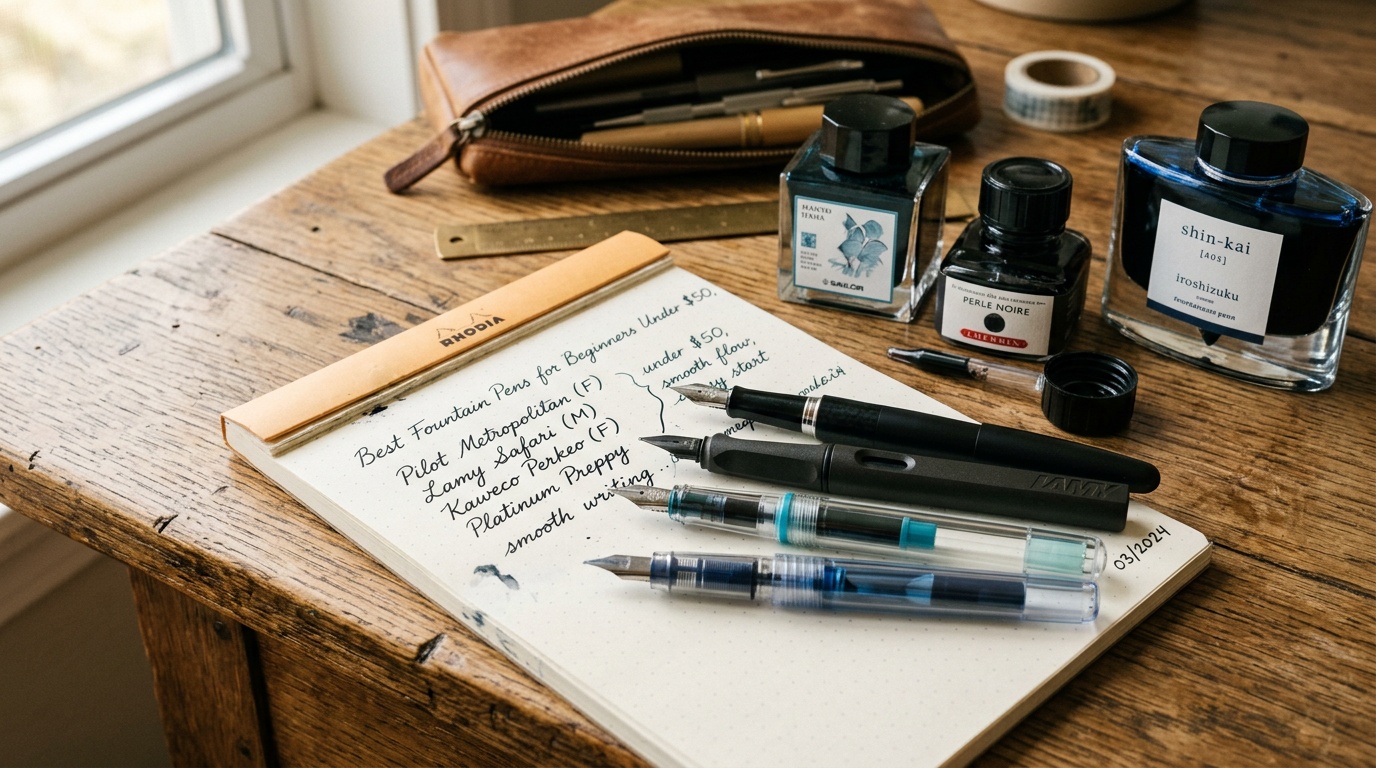
These are ranked by how easily their design translates into a good first purchase. The lower-ranked pens are better choices for particular hands and priorities, so use the tradeoff column before deciding that first place must be right for you.
- Best default: Pilot Kakuno. Low weight, approachable grip, and room in the budget for supplies.
- Best for intermittent use: Platinum Plaisir. A cap designed to resist drying and a light metal body.
- Best traditional presentation: Pilot Metropolitan. A brass body and restrained appearance, with a grip worth checking carefully.
- Best for changing nib widths later: LAMY Safari. A practical body and replaceable nib system, conditional on grip comfort.
The following ranges describe sensible prices to look for in standard finishes. Limited editions and accessory bundles can cost more without improving the writing experience.
| Pen | Shopping budget | Starting nib | Main advantage | Main tradeoff |
|---|---|---|---|---|
| Pilot Kakuno | About $15–20 | Fine; medium for larger writing | Light, simple introduction | No pocket clip; shaped grip |
| Platinum Plaisir | About $18–25 | Fine, marked 03 | Drying-resistant cap | Basic-looking grip and nib |
| Pilot Metropolitan | Aim for $25–35 | Fine or medium | Traditional brass construction | Narrow grip with a barrel step |
| LAMY Safari | About $30–37 | Fine for notes | Replaceable nibs and useful clip | Pronounced grip facets |
1. Pilot Kakuno: the strongest starting point
The Kakuno’s design makes the writing position easy to understand. Its triangular grip encourages finger placement, while the small face on the nib indicates which side should face upward. The hexagonal body discourages rolling. These features and its included black cartridge are described on Pilot’s Kakuno product page. The styling is playful, but the usability decisions are practical.
My verdict: the Kakuno earns its place by making the first purchase inexpensive and understandable. Choose fine for compact notes; medium is the more sensible alternative if extremely narrow lines are not your priority. The lightweight body is especially appealing for extended writing, although anyone who rotates a pen substantially should check whether the grip facets interfere.
The biggest everyday omission is a clip. This is a pencil-case or desk pen more naturally than a shirt-pocket pen. Clear plastic also exposes ink residue that an opaque barrel hides. That is useful for understanding the pen, but it will not maintain a pristine display-case appearance once filled.
2. Platinum Plaisir: the better choice for an irregular routine
The Plaisir puts its strongest engineering feature inside the cap. Platinum’s Slip & Seal mechanism is designed to limit evaporation while capped. The manufacturer makes a one-year drying-resistance claim on its Plaisir page; treat that as a manufacturer claim, not a guarantee under every ink and storage condition. The practical advantage is especially relevant when writing is occasional.
I rank cap sealing above a heavier barrel for a pen that spends most of its life waiting. A Platinum Plaisir 03 fine fountain pen is the pick for weekly planning or a desk drawer. Standard versions are listed around $18 by The Gentleman Stationer, although colors and sellers vary.
Its aluminum body adds a metal exterior without the heft of brass. The transparent grip and small nib look utilitarian beside the Metropolitan. Choose it for that combination of low weight and cap design, not for decorative detailing. It uses Platinum cartridges; budget for a compatible Platinum converter separately if bottled ink becomes part of your routine.
3. Pilot Metropolitan: choose it for the body
The Metropolitan makes sense when appearance and material feel are part of the purchase. Pilot specifies a brass barrel and stainless steel nib in its fine-writing brochure. It looks appropriate beside a work notebook, and its pocket clip makes carrying it more straightforward than carrying a Kakuno.
The caution is where the barrel narrows into the grip. That step can land directly beneath fingers held high on the pen, while the narrower section may encourage a tight pinch. Evaluate it with the cap off the back first: posting, or placing the cap on the barrel while writing, changes the balance.
At roughly $25–35, it is a reasonable purchase for someone who wants this particular body. It is not an automatic writing upgrade over the Kakuno. Verify the regional version and included accessories: MR-family listings and cartridge arrangements can differ by market. A U.S. Metropolitan takes Pilot cartridges, but a listing’s photograph alone is insufficient to establish what arrives.
4. LAMY Safari: excellent when the grip fits
The Safari combines a light, impact-resistant plastic body, ink window, prominent clip, and strongly shaped grip. LAMY’s U.S. listing shows a $37 regular price, an included blue T10 cartridge, and the Z28 converter as an accessory. That leaves it below the pen-only ceiling, but buying bottled ink and a converter immediately can consume the remaining budget.
My Safari verdict: grip comfort decides the purchase before the replaceable nib does. If its facets match your natural hold, they provide an obvious, repeatable position. If your fingers straddle their edges, a different nib will not solve the discomfort. Hold one in a shop if possible, or use a seller with a clear return policy.
The longer-term benefit is that compatible replacement nibs are sold separately. LAMY explains its slide-on nib system, which lets you explore another width without replacing the whole pen. Start with the supplied nib and learn its behavior before buying alternatives.
Who Each Option Fits Best
Choose for the writing you actually do during an ordinary week. A pen that suits five minutes of daily planning may have different priorities from one used for an hour of lecture notes.
- Students and compact note-takers: Kakuno Fine is the first choice, with medium reserved for larger handwriting and suitable paper. Carry it in a case because it lacks a clip.
- Occasional journalers: Plaisir Fine makes sense when the pen stays capped between sessions. Its sealing design addresses a more relevant problem than extra ink capacity.
- Office writers and gift buyers: Metropolitan suits someone who values a traditional appearance and metal body. Grip comfort is the deciding check, especially for long sessions.
- Writers who already like guided grips: Safari offers practical carrying features and future nib options. Left-handed users should judge their actual finger position and ink drying needs rather than assume handedness determines compatibility.
If even $15 feels like too much for an experiment, consider the Platinum Preppy 03 fine fountain pen. A standard version around $7 is a sensible trial purchase; skip expensive bundles. Platinum’s Preppy specifications describe a stainless steel nib and drying-resistant cap. The inexpensive plastic body makes more sense as an introduction or spare than as a purchase driven by material finish.
If you are buying for school, office notes, or general everyday writing, I would lean toward conservative nib sizes and pens with solid cap sealing first. If you are buying because you want to enjoy the hobby side, grip shape and nib-swapping options matter more because they affect how much room you have to experiment later.
This is also where personality starts to matter. Some beginners want the simplest possible success path, while others are happy to trade a little convenience for a pen that feels more distinctive in the hand.
Mistakes I See Beginners Make
Buying the widest nib because it sounds smoothest. A broad line can close the loops in small handwriting and put more ink onto absorbent paper. Choose width for legibility first. If a fine nib feels unpleasant, distinguish gentle paper texture from a sharp catch in one direction; the latter may need seller attention.
Pressing harder when ink does not flow. A fountain pen should write with light contact. Forcing the nib can damage it. Confirm that the cartridge is seated according to the instructions, allow ink time to reach the feed, and try ordinary writing with the nib facing upward. Persistent trouble is a reason to inspect or exchange the pen, not increase pressure.
Change one variable at a time
Begin with the included ink and one notebook. If lines feather, try better paper before replacing the pen. If the pen skips on both papers, check the cartridge and rinse according to the manufacturer’s care instructions. Use cool or lukewarm water for routine cleaning; do not reach for alcohol or force the nib assembly apart.
Keep India ink, acrylic ink, and ordinary dip-pen ink out of these pens. Start with ink explicitly labeled for fountain pens, preferably a straightforward dye-based blue or black. Shimmer and specialized permanent inks can wait until cleaning and normal ink flow are familiar.
Check the refill before checking out
Pilot, Platinum, and LAMY do not share one universal cartridge. Match the refill to the actual model and regional version, and check whether a converter is included. A cheap pen bundled with incompatible supplies is poor value. Also confirm that a Metropolitan or Safari listing is for the fountain pen, since those names appear on other writing instruments.
During the return window, write a full page, pause with the cap on, and return to it later. Try normal sentences, small loops, and light strokes in several directions. That simple check reveals more useful information about comfort and reliable starting than repeatedly signing your name on glossy packaging.
Bottom Line
Buy the Pilot Kakuno Fine for the most straightforward start under $50. Choose medium for larger handwriting on suitable paper. Use its cartridge, buy a modest notebook, and leave the remaining budget unspent until you have a clear reason to change something.
Choose the Plaisir instead if writing is intermittent, the Metropolitan if its metal body and narrow grip suit you, or the Safari if you already know its facets feel comfortable. The right first fountain pen starts reliably, fits your hand, and keeps your everyday writing legible. None of those requirements demands spending the full fifty dollars.
If you want the safest recommendation, I would keep the decision boring on purpose: reliable brand, fine or medium nib, straightforward ink, and a body shape you will actually enjoy holding for a page or two. That formula is not flashy, but it is what sets up most new fountain-pen users for a good first month.
Scope, uncertainty & affiliate disclosure
Writing feel is personal. Product details can vary by version, and NibGuide does not imply that every item mentioned was personally purchased or tested.
Some links may be affiliate links. NibGuide may earn a commission at no added cost to you; this does not determine editorial conclusions.
Leave a Comment