On this page
Affiliate Disclosure: Some links in this article are Amazon affiliate links. If you purchase through them, I earn a small commission at no extra cost to you. I only recommend products I’ve personally used or vetted through the pen community.
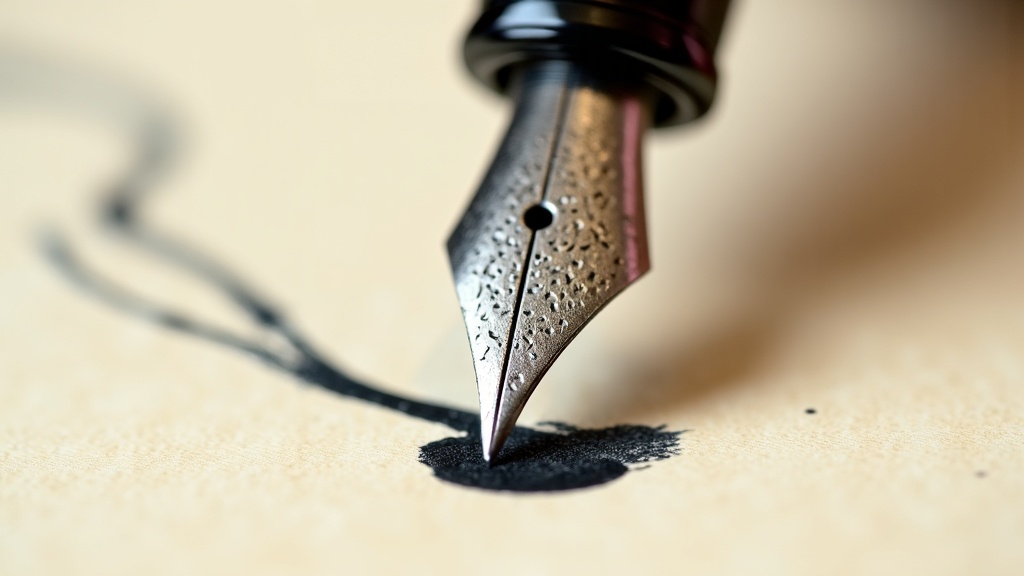
You sit down for your morning writing session, uncap your favorite pen, and the first stroke dumps a river of ink onto the page. Feathering, bleed-through, smearing before you even lift the nib — a too-wet fountain pen can turn a joy into a frustration fast. I’ve been there more times than I care to admit across 10 years of collecting and testing 200-plus pens.
The good news: a wet nib is usually fixable, and in many cases you won’t need to touch the metal at all. This guide walks through the full diagnostic process — what’s actually causing your nib to run wet, how to tell whether you need to adjust the nib itself or just switch inks, and the step-by-step methods for dialing things back when adjustment really is the answer.
What “Wet” Actually Means in Fountain Pen Terms
In the fountain pen world, “wet” describes a nib that delivers more ink per stroke than the paper or use case calls for. But wetness isn’t one single thing — it’s the result of several interacting variables inside the nib and feed system.
Ink channel width and tine gap. The two tines of a nib form a capillary channel down the center (the slit). When that gap is wide, more ink flows. When it’s tight, less does. The tine gap is the most direct mechanical control over flow volume.
Feed geometry. Below the nib sits the feed — the black plastic or ebonite component with channels and fins that regulate ink delivery. Feeds do double duty: they supply ink to the nib and vent air back into the converter or cartridge. A feed that’s cut with generous channels, or that fits loosely in the section, can contribute to oversupply.
Tipping material and grind. The small ball of tipping alloy welded to the nib’s tip affects how ink is deposited on paper. A very smooth, broad, or round tip releases ink more readily than a crisper italic or needle-point grind. This is why the same pen with a BB nib feels significantly wetter than with an F.
Ink viscosity and surface tension. Ink isn’t passive. High-lubrication inks (many iron galls and some reds) wick more freely through the nib channel than drier inks. Ink viscosity interacts with nib geometry to determine the final line quality.
Understanding which of these is driving your problem is the whole point of diagnosis — because the fix differs depending on the root cause.
Why Your Nib Is Running Too Wet: Common Causes
Before you grab tools, you need to know what you’re dealing with. These are the most common culprits:
Factory Tuning Variation
Mass-market pens are tuned to a range, not a single spec. Some units come out of the factory with tines slightly wider than nominal — that pen writes wetter. It’s not a defect per se, but it may not suit your preferences or paper. Japanese nibs (Pilot, Platinum, Sailor) tend to be tuned drier from the factory; European nibs (Pelikan, Montblanc, some Italians) skew wetter. If your pen has always been wet from day one, this is likely the explanation.
Tine Gap Spread Over Time
Nibs can flex during writing — sometimes unintentionally. If you write with heavy pressure or have accidentally “sprung” a nib even slightly, the tines may have spread permanently. This is especially common with softer gold nibs. A nib that wasn’t always wet but has become wetter is a signal to check the tine alignment.
Ink Choice
Highly lubricated inks amplify whatever flow tendencies your nib already has. If you’ve recently changed inks and the pen now writes wet, the ink is probably the variable. Troubleshoot ink before touching the nib — it’s reversible, free, and fast.
Filling System or Converter Pressure
Eyedropper-converted pens and large-capacity pistons hold more air above the ink reservoir. On warm days or as the cartridge empties, pressure fluctuations can push extra ink through the feed. If your pen writes wet intermittently — especially after temperature changes — pressure is worth investigating.
Feed or Nib Seated Improperly
On pens where the nib and feed can be pulled (most demonstrators and many entry-level pens), these components can slip out of their optimal position. A feed rotated slightly or pushed in too far throws off the ink-air balance. This is easy to check and even easier to fix.
Diagnosing Before You Touch Anything
I cannot stress this enough: do the diagnostic checklist before adjusting the nib. Nib work can be irreversible. Ink is free. Always rule out the reversible causes first.
Step 1: Swap the Ink
Flush the pen completely, then fill with a known-dry ink. Good reference inks for testing dryness: Pilot Iroshizuku (most colors run fairly dry), Diamine Oxford Blue, Waterman Serenity Blue, or any Platinum Classic series. Write a test paragraph on your usual paper. If the problem disappears, the issue was ink, not the nib.
Step 2: Test on Different Paper
Cheap paper and uncoated stock feather and bleed far more than quality writing paper. Rhodia, Clairefontaine, Tomoe River, and Leuchtturm1917 are fountain pen-friendly. If your wet writing issues only appear on certain paper, the paper is the variable — not something to “fix” in the nib.
Step 3: Inspect the Nib and Feed Seating
On pens that allow it, pull the nib and feed unit (grip the feed firmly and rotate gently — never yank). Check that the feed channel runs directly down the center of the nib slit. Confirm the feed fins are properly aligned. Re-seat everything snugly and test again.
Step 4: Use a Loupe
A 10x jeweler’s loupe is the single most useful tool for nib work. Look at the tine gap from the front of the nib. The two tines should be symmetrical and nearly touching at the tip, with a hairline gap visible when held up to light. A visibly wide gap — one you can see clearly without magnification — is almost certainly contributing to wetness.
Also check the tip: is the tipping material smooth and round, or is there any burr or asymmetry? A chipped tip creates turbulence that can increase ink delivery.
Step 5: Check for Air Bubble Issues (Eyedroppers and Pistons)
If you have an eyedropper or large piston pen, try the “burp” test: hold the pen nib-down, loosen the barrel or twist back the piston slightly to release any pressure, then retighten. If subsequent writing is drier, pressure management is the issue.
DIY Adjustment Methods (With Clear Warnings)
If diagnosis points to the nib itself — specifically the tine gap — you have options. Approach these in order from most reversible to least.
Method 1: Brass Shim Adjustment (Recommended First Attempt)
Brass shims — thin strips of metal — can be used to narrow an overly wide tine gap with very little risk of permanent damage. Brass shim stock is available in rolls or packs and can be cut to size. The classic material used by nibmeisters for this purpose is 3M Mylar tape (polyester film tape), which provides a flexible, consistent thickness.
How to do it:
- Cut a strip of Mylar or thin brass shim approximately 5mm wide and 20mm long.
- Slip it between the tines, gently, from the back of the nib toward the tip — stopping before the tipping material.
- Slowly draw the shim out toward the tip while applying very slight downward pressure. This closes the tine gap incrementally.
- Test on paper. Repeat as needed with more passes, or a slightly thicker shim.
Warning: Over-closing the gap will cause hard starts, railroading (ink skipping), or complete stoppage. Go slowly. One or two light passes is usually enough for a wet-tuned nib.
This method is reversible in the sense that you can reopen a closed nib — but every adjustment does put microscopic stress on the metal. Don’t make this a daily habit.
Method 2: Manual Tine Pressure
For nibs where the tine gap is noticeably wide (visible without magnification), some collectors will very gently squeeze the two tines toward each other using fingertips. I’m less enthusiastic about this method because it’s harder to control and easier to apply uneven pressure, which can misalign the tines.
If you try it: use padded fingertips (or wrap the nib in a cloth), apply pressure at the very base of the tines (not the tip), and check with the loupe after each micro-adjustment.
Irreversibility warning: Tine adjustment done incorrectly can crack the nib, create a permanent misalignment, or break the tipping. If the nib has sentimental or significant monetary value, stop here and see a nibmeister. A fine tuning session from a reputable nibmeister runs $25–50 and is well worth it on a pen you care about.
Method 3: Feed Adjustment
On pens with ebonite feeds, some nibmeisters sand or trim the feed channels to reduce flow. This is not a DIY operation for most people — it requires understanding exactly how much material to remove and the judgment to stop in time. I mention it only for completeness. On plastic feeds, this is even more risky because the tolerances are tighter and the material less forgiving.
When to Use a Drier Ink Instead of Adjusting the Nib
Here’s my honest opinion after years of dealing with wet nibs: ink swapping fixes the problem 60% of the time without any risk to your nib. There’s no trophy for suffering through an overly wet pen just to avoid changing inks.
Consider the ink-first approach when:
- The pen writes wet only on certain paper types
- You recently changed inks and the problem is new
- The pen came with a highly lubricated ink pre-loaded (some new pens ship with demonstration ink)
- The wetness is mild — manageable with a slight adjustment to writing angle or speed
- The nib is on an expensive or vintage pen where any mechanical adjustment carries risk
Drier ink recommendations worth keeping on hand:
- Waterman Serenity Blue — legendarily dry, one of the best for wet nibs
- Pilot Iroshizuku Ina-ho — dry with good flow consistency
- Diamine Registrar’s Ink — iron gall, dry, water-resistant bonus
- Platinum Carbon Black — extremely dry, excellent for control
You can find a good assortment of fountain pen ink samplers that let you test dryness without committing to a full bottle. That’s how I approach new pens now — start with an ink I know is dry, establish a baseline, then experiment from there.
When to Send to a Nibmeister
There are situations where professional work is simply the right call:
- Vintage nibs. Pre-war and early postwar nibs are often softer, more brittle, or metallurgically different from modern nibs. The margin for error is smaller. Send these to a specialist.
- Expensive nibs ($200+). At this price point, a $35 nibmeister tuning is cheap insurance. My own rule: anything over $150 MSRP gets professional tuning if I need work done.
- Gold nibs with tine misalignment. If one tine sits higher than the other (look at the tip straight-on), fixing this without tools is very difficult. A nibmeister has the dedicated tools and technique.
- Nibs that didn’t respond to shim adjustment. If you’ve tried shimming and the pen is still too wet, something else may be going on — a feed issue, a nib design issue, or a seating problem that needs a trained eye.
Reputable nibmeister services I’ve used or can personally vouch for through the SF pen community: nib adjustment tool kits can help with minor work at home, but for serious tuning, vendors like Pendleton Brown, Mike Masuyama, and John Mottishaw have well-established reputations in the community.
Alex’s Philosophy: Adjust vs. Swap
My approach after testing 200-plus pens has settled into something pretty simple: the pen should work with the inks I want to use on the papers I like. If a wet nib prevents that, I fix it — but I always start with the least invasive intervention.
The hierarchy I follow:
- Swap paper first. Upgrade to fountain pen-friendly paper and see if the problem disappears. (Often it does.)
- Swap ink second. Try a dry ink and establish whether the nib itself is the problem or the ink is amplifying a marginal nib.
- Re-seat the nib/feed. Check alignment, reseat, test.
- Shim the nib. Light passes with Mylar, slow and careful.
- Professional tuning. When the above don’t resolve it, or when the pen’s value warrants expert attention.
One last thought: wet nibs are not universally bad. A broad, wet-writing nib on good paper is one of the great pleasures of this hobby. Before you adjust anything, make sure the nib is actually too wet for your needs — or whether it just needs the right paper and ink to shine.
If you’re building out your diagnostic toolkit, a good 10x jeweler’s loupe and a pack of nib adjustment shims are the two most useful additions to your pen desk. With those two tools and the process above, you can resolve the vast majority of wet nib issues without risking your pen to unnecessary mechanical work.
Have questions about a specific pen or nib? Drop them in the comments — I read everything and happy to help troubleshoot.
Scope, uncertainty & affiliate disclosure
Writing feel is personal. Product details can vary by version, and NibGuide does not imply that every item mentioned was personally purchased or tested.
Some links may be affiliate links. NibGuide may earn a commission at no added cost to you; this does not determine editorial conclusions.
Leave a Comment