
On this page
I maintain specialty nibs by matching the ink to the pen, flushing before changing ink types, and cleaning before residue dries inside the feed. A stub, italic, flex, or fude nib does not automatically need a special cleaning chemical. It needs compatible ink, gentle handling, and a routine that suits how often you actually write.
If you’re trying to make a smart choice instead of buying twice, my first priority is preserving the nib geometry: the shape and alignment that make those distinctive lines possible. Scrubbing a sharp italic or repeatedly pulling a flex nib can create a bigger problem than the original ink deposit. Here is how I would set up a beginner’s maintenance routine without buying a drawer full of tools.
The Short Answer
For specialty fountain pen nibs, start with ink explicitly made for fountain pens and use cool or room-temperature water for routine cleaning. Flush when changing formulations, when flow deteriorates, and before putting the pen away unused. Plain dye ink is usually the easiest starting point. Shimmer, pigment, and iron-gall formulations deserve closer attention to the manufacturer’s instructions and to drying between uses.
For removable dip nibs, clean after every session and dry thoroughly before storage. India ink, acrylic ink, and many opaque calligraphy inks belong with compatible dip pens or brushes, not inside an ordinary fountain pen. “Calligraphy” describes a use, not compatibility: a cartridge-filled calligraphy pen is still a fountain pen. If the bottle does not clearly support your filling system, do not experiment inside it.
Why This Matters More Than Most Beginners Think
A fountain pen moves ink through narrow passages in the feed, the component underneath the metal nib. Cleaning the shiny surface alone does not clear those passages. Specialty shapes also make it easier to mistake writing technique or paper behavior for a blockage.
- Stubs and italics need consistent contact. Their broad writing edges can skip when rotated off the intended angle. More pressure will not correct that angle and can damage the nib.
- Flex nibs can demand ink faster than the feed supplies it. Two parallel lines with an empty center, called railroading, can reflect excessive spread or writing speed rather than dirt.
- Fude nibs change line width with angle. Their intentionally bent tips should never be straightened as a cleaning or alignment “fix.”
- Dip nibs expose ink directly to air. Ink can build up during a session, while moisture left on susceptible steel after washing encourages rust.
My verdict: diagnose the writing behavior before reaching for a tool. A pen that skips only when you rotate an italic nib needs a different response from one that gradually loses flow across an entire page. That distinction saves nibs and prevents unnecessary purchases.
Paper belongs in the diagnosis
Test on a smooth, known fountain-pen-friendly sheet before deciding the feed is clogged. Rough or fibrous paper can catch a sharp nib and leave fibers near the slit. Absorbent paper can make a wet stub look feathered and uncontrolled; less absorbent paper may show more sheen but need longer drying time. Neither result proves that the nib needs cleaning.
Keep a reference sample: a few normal lines, broad strokes, and light-pressure strokes using the same paper and a familiar ink. Change one variable at a time. If a problem appears only with a new notebook, investigate the paper before adjusting the pen.
What I Look for First
Before choosing a maintenance routine, identify the entire pen-and-ink combination. Nib width alone tells you surprisingly little about cleaning access, cap sealing, or the materials that can tolerate soaking.
- Filling system: A cartridge/converter pen usually allows separate rinsing of the removable converter. A piston or vacuum filler normally gets flushed using its own mechanism.
- Ink label: Confirm fountain pen compatibility, then identify whether it contains shimmer, pigment, or iron-gall ingredients. “Water-based” and “waterproof” are not sufficient compatibility information.
- Materials and service instructions: Vintage sacs, decorative finishes, wood, and unfamiliar plastics need model-specific guidance. A removable nib unit does not necessarily mean the nib and feed should be pulled apart.
- Use pattern and cap seal: A pen used daily is easier to monitor than one forgotten in a case. Recurring hard starts after capped storage may point to evaporation through an inadequate seal.
A modest 10x inspection loupe can help you spot paper fibers or obvious tip damage without poking the slit. It is optional; bright light is enough for routine checks. Magnification is for observation, not an invitation to bend the tines. As an Amazon Associate, I earn from qualifying purchases.
Plain dye and heavy-sheening inks
A straightforward dye-based fountain pen ink is my preferred baseline when learning a specialty nib. It lets you establish normal flow before adding suspended particles. Flush at color changes when clean color matters, and whenever you switch to a different ink formulation.
Sheen is not shimmer: a contrasting surface effect does not, by itself, mean glitter particles are present. Some highly saturated inks leave persistent color during rinsing or become troublesome when allowed to dry. Start with water and patience. A faint tint in rinse water is not a reason to dismantle a well-functioning pen.
Shimmer inks
Shimmer contains suspended particles, so both flow and cleanup deserve attention. Diamine, for example, explicitly sells its Tropical Glow shimmer as fountain pen ink; that designation matters, but it does not guarantee equal performance in every feed. A broad nib may display shimmer well while the passages beneath it still restrict particles.
Follow the bottle’s mixing directions before filling, and gently roll a capped pen when particles settle during use. Avoid violent shaking. Start with a small fill in a pen you can flush easily. If flow repeatedly stalls, clean it and try a different pairing instead of widening the slit. For occasional sparkle, a compatible dip pen can eliminate the burden of leaving particles in a reservoir.
Pigment and waterproof fountain pen inks
Use pigment ink only when its label specifically permits fountain pens. Do not treat artist acrylic or India ink as interchangeable just because each can make a water-resistant line. Cap promptly and pay attention to developing hard starts.
Sailor’s pigment-ink guidance recommends regular use, secure capping, and washing approximately every two months even with frequent use. That is guidance for its products, not a universal deadline. For a new combination, check flow each session and flush sooner if it changes. Empty and clean the pen before an extended period of disuse.
Iron-gall inks
Choose a modern formula intended for fountain pens, not a traditional dip-pen recipe. Rohrer & Klingner’s writing-ink range includes iron-gall formulations intended for fountain pens, illustrating why the specific product matters more than the category name alone.
Check both pen and ink guidance, especially with vintage or plated components. Keep the ink from drying in the pen, rinse before changing formulations, and monitor exposed metal for changes. A gold nib does not make every other component immune to damage. If ordinary flushing leaves a stubborn deposit, seek the ink maker’s cleaning instructions rather than improvising an acid or ammonia mixture.
How to Choose Without Overbuying
You can handle most routine maintenance with two clean cups, water, and a soft, lint-free cloth. Spend on access and observation before chemicals. My buying rule is simple: each accessory should solve a problem the existing filling mechanism cannot solve conveniently.
- Start with the supplied converter or filling mechanism. Repeated filling and expelling of clean water often handles ordinary ink changes.
- Add a bulb only when it fits safely. A fountain pen cleaning bulb syringe can speed up flushing a compatible cartridge/converter section. Do not force an oversized nozzle onto its connector.
- Buy cleaner only for persistent residue. Choose a fountain-pen-specific product approved for your pen’s materials and the ink involved. Water should come first.
- Keep a consistent paper sample. A small smooth fountain-pen-friendly notebook is useful for comparing flow before and after cleaning. You do not need premium paper for every page you write.
I would buy one reliable cleaning accessory before a second bottle of experimental ink. But if your converter already flushes the pen comfortably, save the money. An ultrasonic cleaner, polishing kit, and stack of brass shims are not beginner maintenance essentials.
A repeatable fountain pen cleaning routine
- Empty the old ink. Work over a protected surface and do not return used ink to the original bottle. Remove the cartridge or converter only as the pen’s instructions allow.
- Flush with fresh water. Draw in and expel cool or room-temperature water using the filling mechanism. Change the water regularly rather than recirculating the same inky cup.
- Rinse accessible components separately. A removable converter can retain ink around its opening. Use gentle bulb pressure only on a compatible section, stopping if water will not pass.
- Soak only approved parts if needed. Check the model’s instructions for what can be immersed and for how long. Do not submerge the whole pen by default; water can enter decorative or inaccessible spaces.
- Check the rinse. Look for substantially clear water and no obvious loose residue. Shimmer can take additional cycles, but a cosmetic trace does not justify forceful disassembly.
- Drain and blot gently. Touch a soft cloth to the nib to wick water away without dragging across the tip. Let permitted components air-dry before storage, and let residual water drain before refilling so it does not dilute the ink.
- Refill and test lightly. Write on your reference paper at the normal angle. If flow remains poor, stop and investigate rather than applying extra pressure.
Sailor’s maintenance instructions similarly emphasize water flushing and cleaning when changing inks or storing a pen. They also identify models for which soaking is inappropriate. Treat your own pen’s instructions as the deciding authority, particularly for vintage construction and unfamiliar materials.
A separate routine for dip nibs
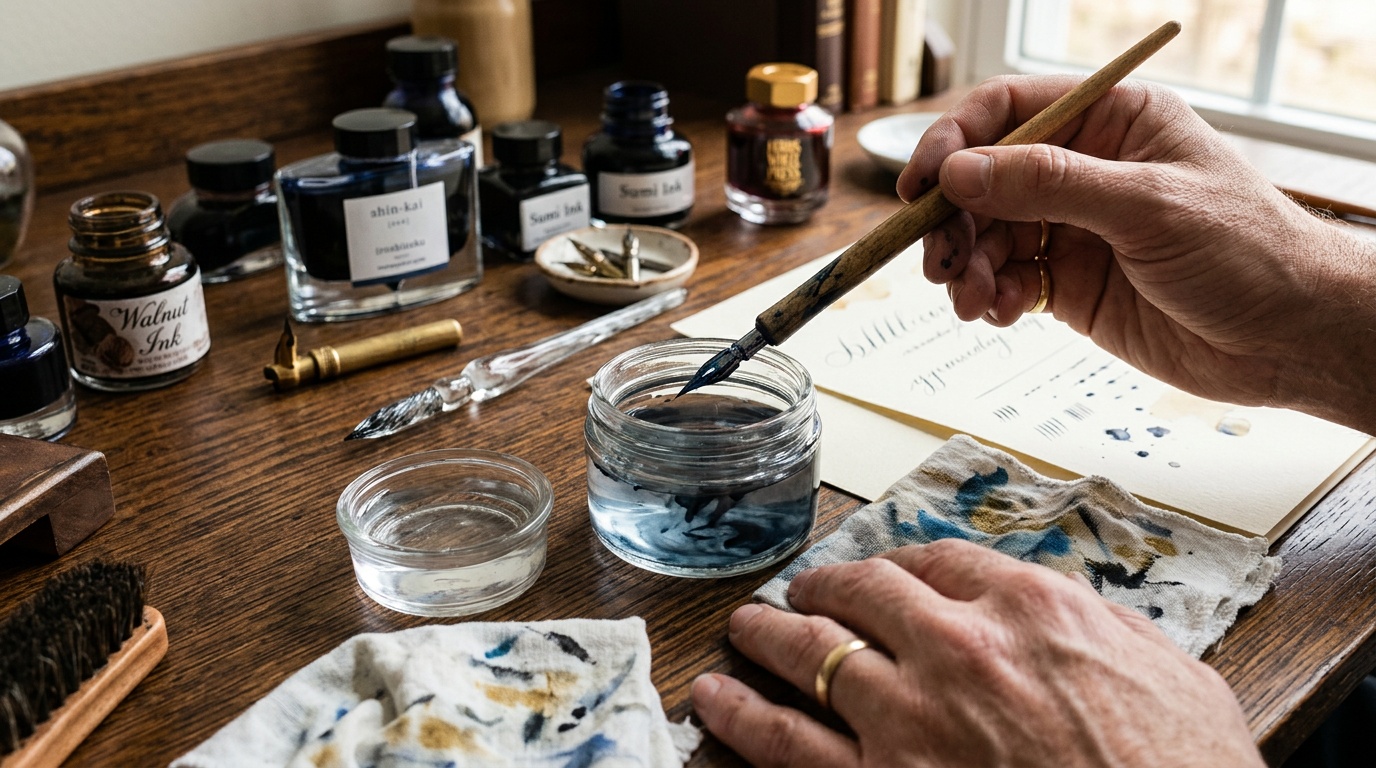
Rinse compatible metal dip nibs during a session before ink forms a heavy crust, keeping water away from wooden holders and trapped spaces. At the end, remove the nib if the holder is designed for removal, clean accessible surfaces gently, and dry everything thoroughly. Do not leave ordinary steel dip nibs soaking overnight.
For dried acrylic or India ink, use a cleaner explicitly suitable for that ink and nib. Speedball’s calligraphy catalog identifies its pen cleaner for acrylic and India inks; that does not make it a general recommendation for fountain pen internals. Follow the product directions and rinse as instructed.
If a new dip nib sheds ink in beads, its protective manufacturing coating may need removal according to the maker’s directions. Do not flame it or scrub the point with abrasive material. Replace inexpensive dip nibs that become rusty, distorted, or persistently snaggy after cleaning.
Common Mistakes and Misconceptions
Cleaning is not nib tuning. Do not push a sewing needle, blade, or shim through the slit as routine maintenance. Do not polish a specialty tip because it feels different from a round nib. Crisp italics have a smaller comfortable writing angle, and an untipped dip nib can naturally feel sharper. Abrasion changes the writing surface permanently.
Stronger cleaning is not automatically better cleaning. Avoid hot water, alcohol, acetone, bleach, and improvised cleaner mixtures unless the relevant manufacturer expressly specifies a compatible treatment. Do not keep cycling harsh solutions to remove a harmless stain. For an unfamiliar vintage pen, confirm material compatibility before soaking or using any commercial flush.
When cleaning does not solve the problem
If a cleaned pen writes normally with a familiar dye ink but struggles with shimmer, treat that as a pairing limitation. If it scratches in one direction with multiple inks on smooth paper, suspect alignment or damage. If a flex nib only railroads under heavy spread, reduce pressure and speed before blaming the feed.
Stop using the pen if the tines stay spread, the feed moves, or corrosion becomes visible. Persistent problems after an appropriate water cleaning deserve help from the maker or a qualified repairer. Repeatedly removing a friction-fit nib can loosen the assembly; the fact that someone dismantled the same model online does not make that a required cleaning step.
Bottom Line
Maintain specialty nibs by protecting their shape and preventing ink from drying where it must flow. Start with an uncomplicated fountain pen ink, establish normal behavior on consistent paper, and add more demanding formulations deliberately. Flush between ink types, follow material-specific cleaning instructions, and clean and dry dip nibs after each session.
My final verdict: the best setup is one you can maintain comfortably. Choose easy flushing and a dependable cap seal before chasing the widest line or brightest shimmer. If a particular ink turns every writing session into troubleshooting, change the ink pairing before you change the nib.
If you want the safest beginner answer, I would still lean fine or medium before anything more extreme. Those widths usually give you enough character to enjoy the pen without forcing you to manage every downside at once.
From there, the smartest upgrade path is not buying more expensive immediately. It is noticing whether you want a cleaner line, more expressive ink behavior, less feedback, or more control on cheap paper. Once you know which direction you want to move, choosing the next nib size becomes dramatically easier.
Scope, uncertainty & affiliate disclosure
Writing feel is personal. Product details can vary by version, and NibGuide does not imply that every item mentioned was personally purchased or tested.
Some links may be affiliate links. NibGuide may earn a commission at no added cost to you; this does not determine editorial conclusions.
Leave a Comment