
On this page
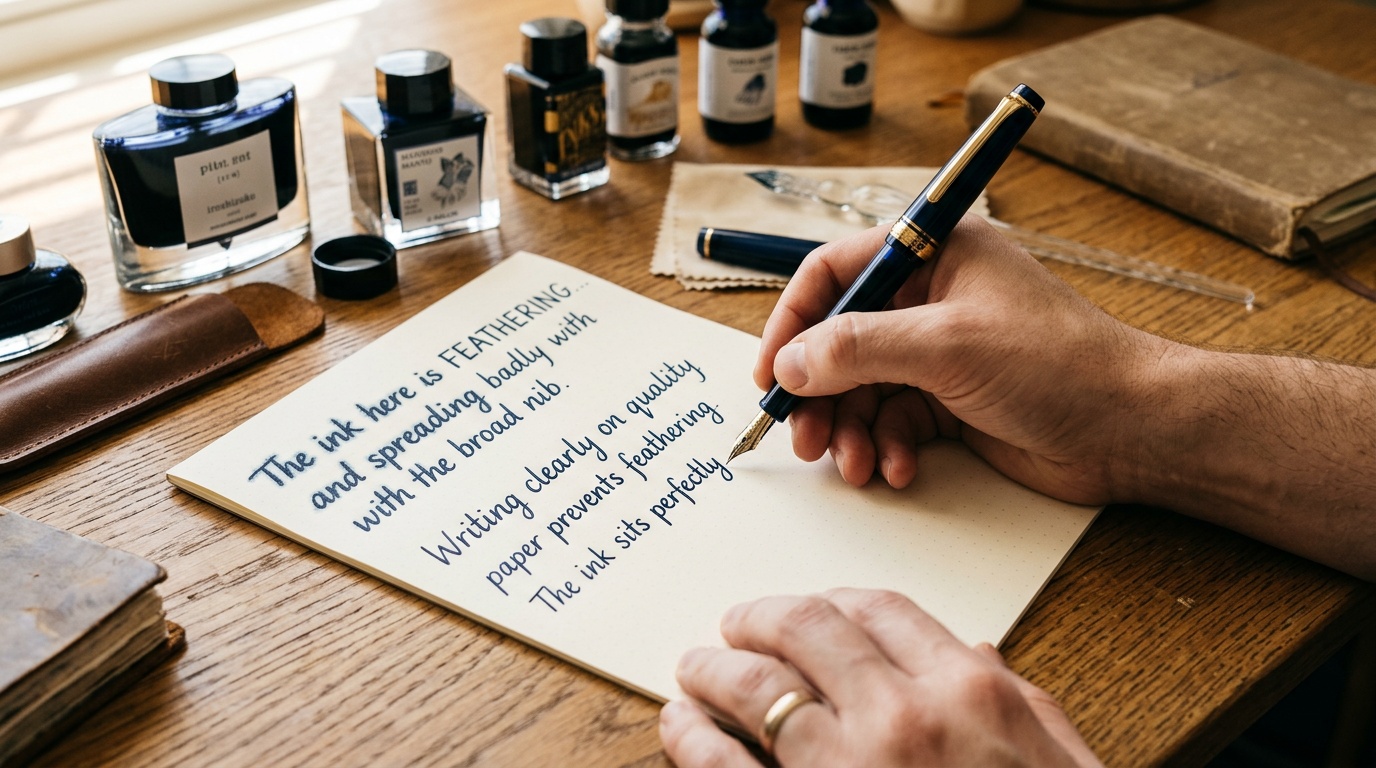
I would change the paper before replacing a broad nib that feathers or bleeds through. Keep the same pen and ink, write a few lines on fountain-pen-friendly paper, and compare the edges and reverse side. If the problem disappears, you have found a paper mismatch without sacrificing the wider line you bought the pen for.
The next move is to test a less freely flowing ink, then investigate the pen only if it still deposits excessive ink across different papers. A broad nib needs a compatible writing surface; it does not automatically need repair. Here is how to separate the symptoms, run a useful comparison, and spend only where it improves your everyday writing.
The Short Answer
To stop feathering or bleed-through with a broader nib, start with paper explicitly intended for fountain pens, write with light pressure, and test your existing ink before buying another bottle. If the paper must stay, try an ink that lays down less liquid in your pen. If neither adjustment produces usable results, a narrower nib may be the practical choice for that particular notebook or workplace form.
Fix the variable you can control first. At your own desk, that is usually paper. On supplied office stationery, it may be ink or nib width. Drying time is a separate issue: waiting longer can prevent smearing, but it cannot pull ink back out of paper fibers after feathering or penetration has happened. A sheet beneath the page protects the next sheet; it does not rescue the back of the page you are writing on.
Why This Matters More Than Most Beginners Think
Several different failures get called “bleeding,” and the distinction determines what is worth buying. Look at a completely dry sample in ordinary reflected light, rather than holding it against a window. Inspect the front, turn it over, and check the sheet underneath. These four descriptions cover most beginner complaints:
- Feathering: tiny branches or fuzzy hairs extend sideways from a stroke. Ink has traveled into surrounding fibers, so letter edges lose definition.
- Bleed-through: ink penetrates the sheet and appears as actual colored spots or strokes on the reverse. Severe cases mark the sheet underneath, but that is not required for bleed-through.
- Ghosting or show-through: writing is visible through the sheet without ink necessarily reaching its reverse surface. The back looks shadowed because the paper is not opaque enough.
- Spread: the line becomes wider than expected while its edges remain fairly smooth. This can close small letter loops even without obvious feathery branches.
A notebook can resist bleed-through well and still show substantial ghosting. If seeing yesterday’s notes behind today’s writing bothers you, you need more opacity as well as ink resistance. Conversely, a thick sheet can hide writing while still allowing fuzzy edges. “Better paper” is too vague a buying criterion until you know which problem you have.
Why the broad nib exposes the problem
A broader nib usually deposits ink across a larger area and often lays down more liquid per length of writing. Paper that copes with a relatively dry fine nib may struggle with a wet broad. But width and flow are separate characteristics: two broad nibs can deliver noticeably different amounts of ink, and a wet medium can challenge paper too.
Paper absorbs and transports that liquid according to its fiber structure and treatments. Sizing is a treatment that helps control liquid penetration; it is not the sheet’s dimensions. As Goulet’s paper demonstration shows, an absorbent surface can turn otherwise ordinary writing into spreading, feathering, and bleed-through. The pen, ink, and paper work as a combination, so judging one without controlling the other two is unreliable.
My verdict: a page with clean, readable writing on both sides offers better value than a luxurious cover wrapped around paper that wastes half the notebook. Decide what a usable page means for your work before paying for binding, branding, or extra thickness.
What I Look for First
Start with the shape and location of the failure. A uniformly fuzzy paragraph suggests something different from one isolated puddle. These checks narrow the problem before you change anything:
- Where the damage appears: feathering along almost every stroke points toward the paper-and-ink pairing. Trouble only at pauses, dots, or retraced letters suggests local saturation.
- Whether another paper fixes it: write the same sentence with the same pen and ink on a known fountain-pen-friendly sheet. This is the highest-value comparison.
- How much pressure you use: a normal fountain pen should write with a light touch. Pressing harder can increase ink delivery on some nibs and damage or disturb paper fibers.
- Whether the behavior changed suddenly: a pen that starts dripping after a refill deserves a seating and leak check. A pen that has always feathered in one notebook deserves a paper test first.
For a reference surface, a small pad is enough. Rhodia 80 gsm notepads are a sensible starting category; choose a size and ruling you will actually use. Rhodia identifies its classic No. 18 pad as using 80 g paper. Check the specific listing because paper specifications vary across notebook ranges.
Run a ten-minute comparison
Use the troublesome notebook and your reference sheet. Keep the same backing surface and write at your normal angle and speed. Avoid judging the first ink-heavy stroke immediately after filling; write a few settling lines first. Label both samples with the ink and nib so the result remains useful after you refill.
- Write two sentences at your usual handwriting size, using your normal light pressure.
- Add a row of small loops and several ordinary dots. These reveal lost definition and concentrated ink deposits.
- Write one word over itself once as a modest stress test. Keep it separate from the normal writing.
- On separate short lines, check smearing after roughly 10, 30, and 60 seconds with clean scrap paper. Extend the interval if needed.
- Once dry, inspect the stroke edges, reverse side, and sheet underneath. Record feathering, bleed-through, ghosting, and acceptable drying time separately.
If only the original notebook fails, changing paper is the clearest next step. If both fail, repeat with a different fountain pen ink after cleaning the pen appropriately. If only the overwritten word bleeds, the paper may still be perfectly usable for ordinary notes. A saturated test patch is useful for finding limits, but it should not overrule a clean paragraph.
This is where I draw the line on testing: a notebook must handle actual handwriting, including punctuation and occasional corrections. It does not need to survive an ink puddle to earn a place on the desk.
Separate nib feel from ink flow
A scratchy point that catches strongly in one direction is not the same problem as a smooth nib that writes wet. Check for visible fibers caught at the tip, and seek adjustment help if the nib snags consistently. Do not sand the tipping or squeeze the tines to treat ordinary feathering. Those changes can create a genuine nib problem while leaving the unsuitable paper untouched.
How to Choose Without Overbuying
Choose around the constraint you cannot change. There is no need to buy a new pen, three inks, and a premium journal simultaneously. That approach costs more and makes it impossible to tell which purchase helped. Use this order:
- Paper is flexible: buy or borrow a small sample of fountain-pen-friendly paper. Keep your existing broad nib and ink for the first comparison.
- Paper is fixed: try a small ink sample that is reported to behave well on absorbent paper. Judge it in your own pen before committing to a bottle.
- Fast drying is essential: test ordinary sentences against your real page-turning or hand-drag interval. Clean edges alone do not make paper suitable for rapid notes.
- Both sides must remain readable: assess opacity after writing a full paragraph on each side. A blank reverse can look acceptable until two blocks of text overlap visually.
Stop buying when the combination meets those requirements. A little show-through may be harmless for a shopping list and unacceptable in a dense work journal. Setting that threshold yourself is more useful than chasing somebody else’s photograph of a perfect ink swatch.
Choose paper by performance, then weight
Grams per square meter, or gsm, describes mass per area. It does not grade fountain pen compatibility. Heavier paper may offer useful opacity, but weight alone cannot tell you how well it controls liquid ink. Likewise, “smooth,” “premium,” and “acid-free” do not guarantee clean broad-nib writing.
Look for writing samples or descriptions covering feathering and bleed-through with fountain pens, ideally using a broad or wet nib. Then test the specific notebook you intend to buy. Do not assume every product from the same brand uses the same paper. If you already like the reference pad’s performance, moving to a notebook with matching paper specifications is a reasonable next experiment, not an automatic guarantee.
A more ink-resistant surface can keep the line crisp while leaving ink exposed longer. That tradeoff matters for left-handed writers whose hands pass over fresh text, and for anyone closing a notebook immediately. Paper that produces dramatic sheen may be enjoyable for correspondence yet inconvenient during a fast meeting.
Choose ink by behavior in your pen
“Dry” ink generally means an ink that flows less freely in a particular setup; it does not necessarily mean quick-drying ink. A fast-drying formula may achieve speed partly through rapid penetration, which can be unhelpful on absorbent paper. Color saturation, waterproofness, and shimmer are also not reliable shortcuts to predicting feathering.
Begin with a straightforward fountain pen ink and change one variable. Pelikan 4001 Royal Blue fountain pen ink is one candidate for a simple comparison, preferably sampled first. It is not a guaranteed cure. Pelikan describes Royal Blue as washable and erasable, so choose something else if water resistance is essential.
Flush out the previous ink according to the pen maker’s instructions, remove excess rinse water, and allow the feed to settle into normal writing before comparing. Residual water or mixed ink makes the result harder to interpret. Do not add detergent to “improve” flow when your problem is too much spread, and do not experiment inside a full bottle.
Buy an accessory only for the problem it solves
If the lines are clean but drying is too slow, fountain pen blotting paper sheets can help before you close the notebook. Touch down and lift without sliding; test first because blotting can lighten the writing and reduce shading. Blotting removes surface ink. It cannot reverse feathering or ink that has already penetrated the sheet.
My spending priority is one compatible paper sample, then one alternative ink sample if needed. A replacement nib comes after those comparisons unless the paper is permanently fixed and the broad line simply cannot meet the job’s requirements.
Common Mistakes and Misconceptions
“A more expensive pen will fix this.” Price does not make ink stay inside a stroke. Gold nibs, heavier barrels, and elaborate filling systems do not compensate for an absorbent sheet. A broad nib that writes cleanly on the reference paper is demonstrating that it can work; replacing the entire pen is an expensive response to that result.
“I should press harder or write unnaturally fast.” Pressure can worsen the problem, while rushing may merely disguise it by reducing dwell time. Use a comfortable pace and lift the nib when thinking instead of parking it on the page. If ordinary handwriting still saturates the paper, change the combination instead of training yourself around a poor fit.
“Waterproof ink must resist bleeding.” Water resistance after drying and penetration during writing are different properties. Pigmented and dye-based fountain pen inks both need testing on the intended paper. Also, inks labeled for dip pens or general calligraphy are not automatically fountain-pen-safe; use a formulation explicitly intended for fountain pens.
“All wet writing is normal for a broad nib.” A generous, consistent line can be normal; drops, sudden flooding, or ink leaking into the cap are different. Check that the cartridge or converter is seated as the manufacturer specifies and inspect for visible damage. If the pen suddenly floods across several papers, contact the seller or maker before attempting feed or tine modifications.
Bottom Line
Keep the broad nib while you diagnose the pairing. Compare your current paper against a fountain-pen-friendly sample, identify whether the failure is feathering, bleed-through, or ghosting, and test an alternative ink only if the first comparison leaves a problem. Judge normal paragraphs, reverse-side readability, and realistic drying time together.
If the paper is nonnegotiable and a less freely flowing ink still fails, use a narrower nib for that task and keep the broad for compatible pages. The useful outcome is predictable writing with clean letter edges and a notebook you can use comfortably. Once you have that, stop shopping.
As an Amazon Associate, NibGuide earns from qualifying purchases.
Scope, uncertainty & affiliate disclosure
Writing feel is personal. Product details can vary by version, and NibGuide does not imply that every item mentioned was personally purchased or tested.
Some links may be affiliate links. NibGuide may earn a commission at no added cost to you; this does not determine editorial conclusions.
Leave a Comment